The summer of 1976 was bicentennial summer, when the United States celebrated its 200th birthday. There were numerous festivities across the country, though the event that everyone seems to remember best is the gathering of tall ships in New York harbor on July 4th. I never understood why that was such a big deal, but given the range of things a country like ours might do for a celebration like that, there’s something appealing about just inviting some sailboats to float by and marveling at the scene.
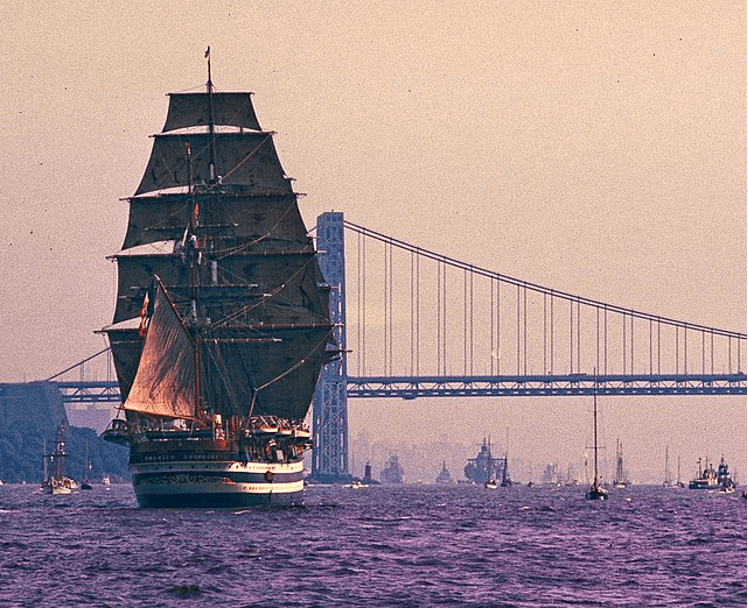
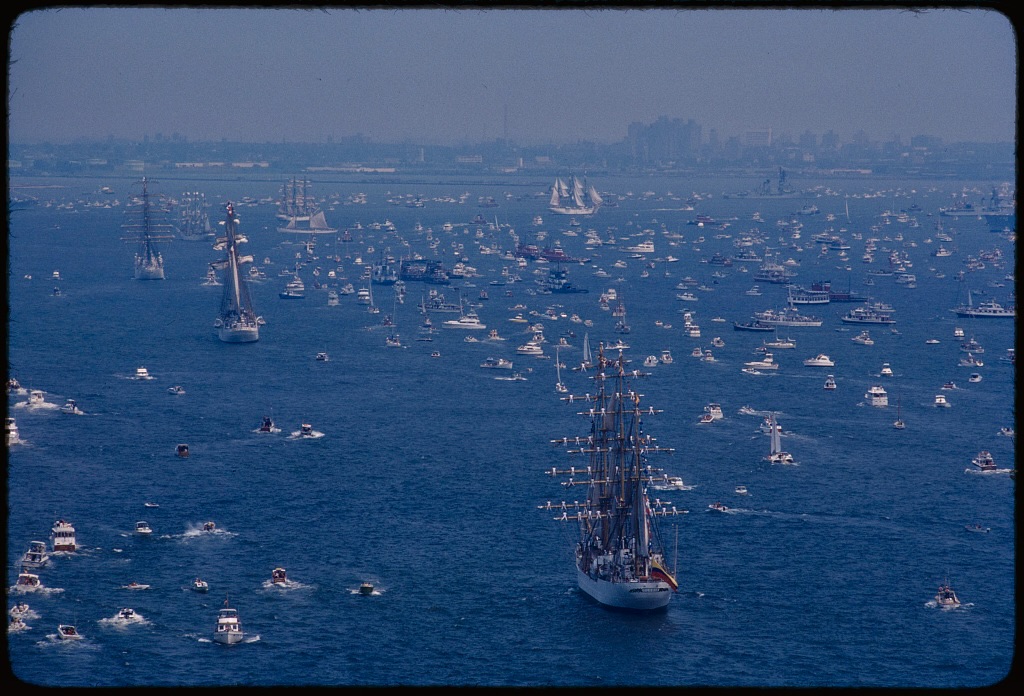
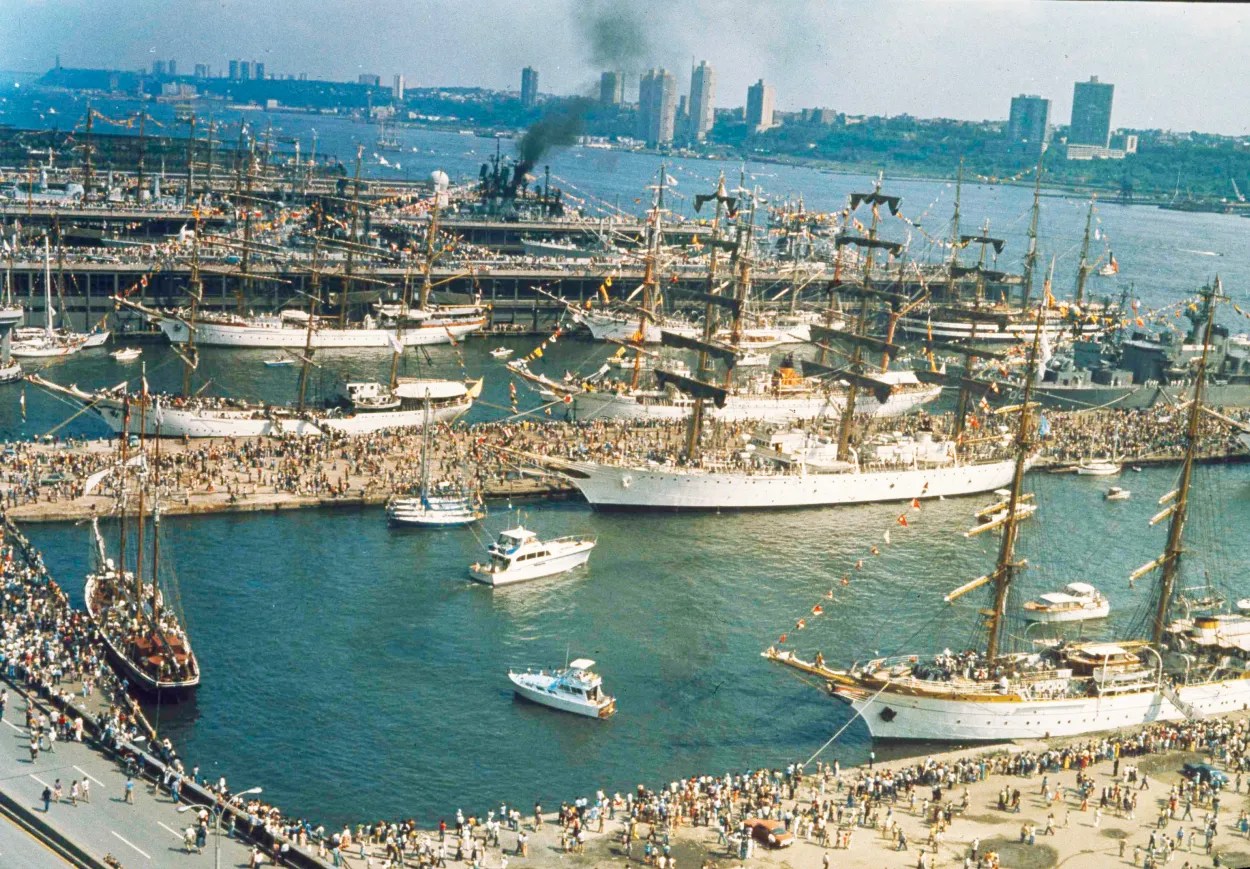
(Photos from the Gotham Center for New York City History and the Library of Congress.)
In my family, the longest-lasting memento of that summer is a needlework design that my mother made: it shows an eagle sitting atop the Liberty Bell, framed by the words “Bicentennial of the United States, 1776 – 1976.” For nearly 50 years, it hung on a wall outside one of the second floor bedrooms in the house on Saint Mary’s Street.
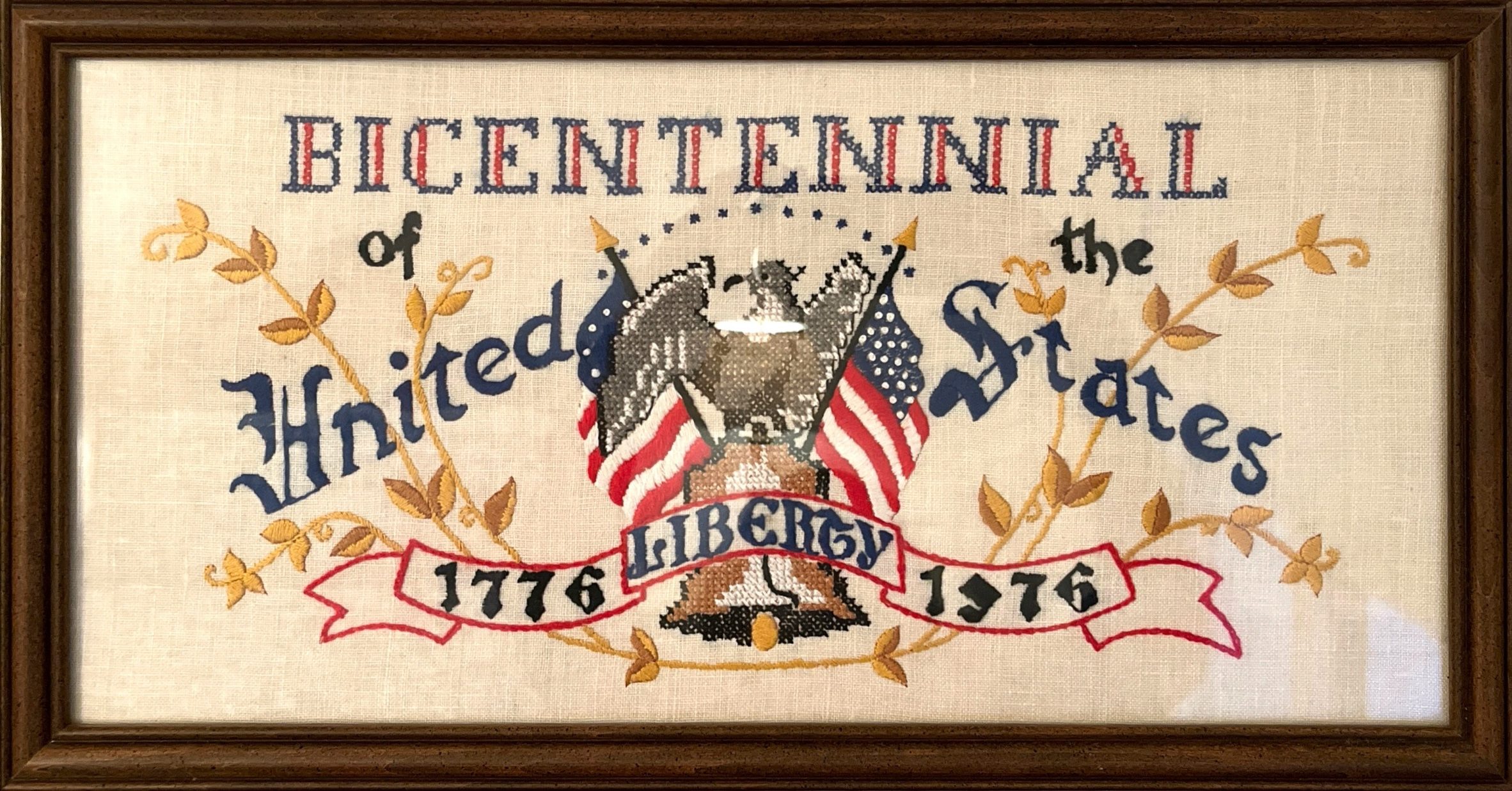
As for that night – July 4, 1976, a Sunday – my parents were surely down at church with their Sunday School class, eating hamburgers in the Fellowship Hall and homemade ice cream outside. The city no doubt put on a fireworks display and hosted an outdoor concert at Meredith College. My mother would have worn something red, white, and blue; my father would have enjoyed it all – I can hear him now, laughing.
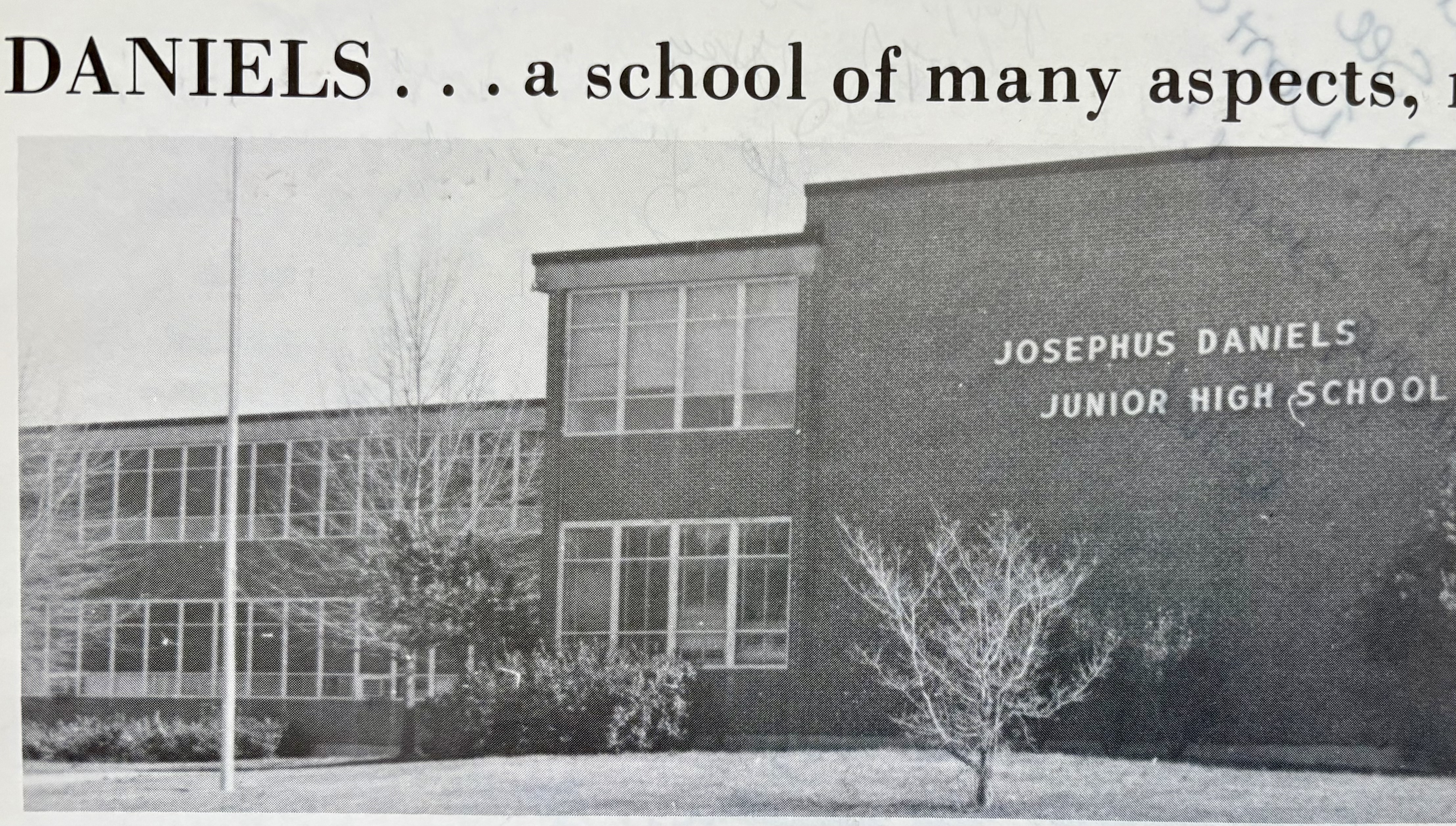
I was fifteen years old that summer, having just finished ninth grade at Josephus Daniels Junior High School (now Oberlin Middle School), and thus, in the system we had at the time, set to start high school in the fall. I was not yet driving, and I didn’t have a full-time job. If memory serves, I cut grass in the neighborhood and took golf lessons at the country club.
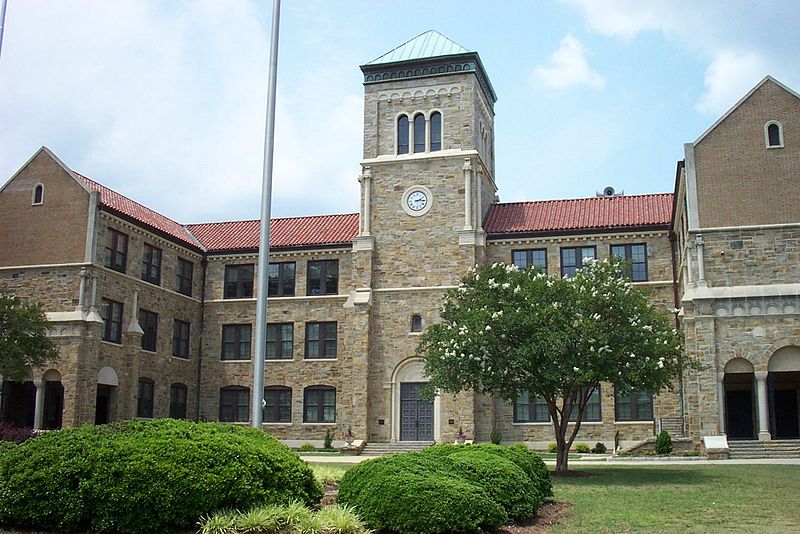
But mostly I was anxious. My best friend Tommy, whom I had known since first grade, was going away to boarding school – indeed, several boys I’d grown up with were heading off to prep school in the fall. I was staying in Raleigh, in public school, starting the tenth grade at Needham Broughton High School downtown. I would be alone, at the bottom of the heap, and at Broughton: to me, a huge, daunting place.
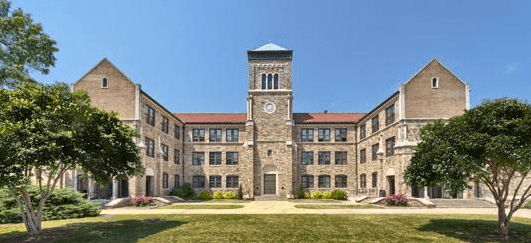
My new school wasn’t actually that much further from home than my old one. But it was further in the direction of downtown, several miles south on Saint Mary’s Street, practically to its end. The drive felt like going back in time, from the 1960s and ‘70s, when my North Raleigh neighborhood was developed, to 1929, when Broughton opened at the end of a decade of extraordinary growth, on land abutting Raleigh’s newest and most desirable streetcar suburbs.
The city had been moving outward for years – especially north and west – and as it did so, it became more segregated, socially, economically, and racially. Soon to come would be Cameron Village (now called the Village District), a shopping, office, and residential development even further out than Broughton, the first sign of an automobile-oriented Raleigh.
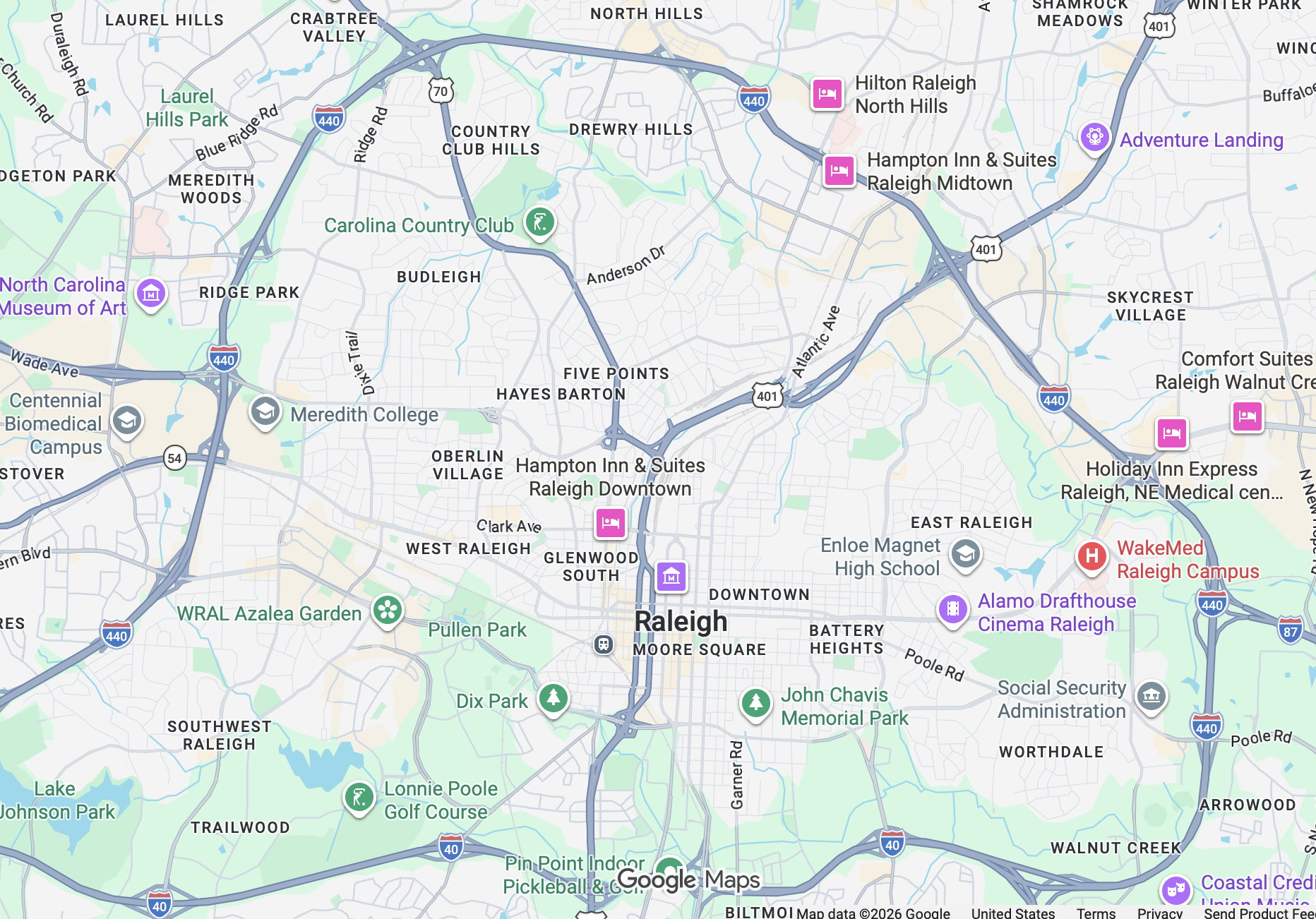
I had spent nearly my entire childhood in North Raleigh, in homes just a few blocks from one another. My elementary and junior high schools, Aldert Root and Josephus Daniels, were there in our part of Raleigh, built in the 1950s and ‘60s. We still went downtown several times a week for church, and to the public library on Fayetteville Street, and we shopped at Cameron Village, where my father had his first office. But our life was concentrated in North Raleigh, a product of cars, growth, and white flight.
A reckoning came in 1971-72, when I was in the fifth grade. That was the year Raleigh finally “desegregated” its schools, after the Supreme Court decision in Swann v. Charlotte-Mecklenburg Board of Education left it little choice. The plan was to bus Black children from South Raleigh to white schools in North Raleigh. It was a plan that no one liked.
By the time I got to Daniels in 1973, the racial tension was nearly unbearable. I remember constant fighting between Black and white students during lunch and after school, sometimes escalating into full-blown brawls that would spill out into the hallways. The fights were especially upsetting because the adults didn’t seem to know what to do about them. I don’t remember police ever being present, and there were no security officers. The assistant principal would try to calm things down, standing between two addled students, or hauling someone off to the office amidst a stream of profanity. But the fear that violence could erupt at the slightest provocation was not easily dispelled.
When I started at Broughton, in the fall of 1976, the conflict had quieted down. Maybe the physical tension had worked itself out and all that remained was a kind of wary coexistence, shot through (as I look back now) with ignorance, misunderstanding, and, on the part of many of us, a shocking amount of apathy.
In any case, that fall, as my best friends left town, heading out into the world, I moved in the opposite direction, into the heart of Raleigh itself, toward downtown, the city’s past, toward a more mixed and, as I would soon discover, a more interesting Raleigh.
My first memories of Broughton are like scenes from a movie: standing on the fringes of the cafeteria, holding a tray, scanning the room for someone to sit with. There was no obvious group for me to join. The third of four children at home, I was used to feeling invisible. And there must have been dozens of kids like me that day, on the fringes, scanning the room. Still, it wasn’t a good feeling.
But, as almost always happens in such situations, things got better, mostly just from the passage of time: attending classes, learning people’s names, trying things out. The movies make the social world of high school the only world. But in a large school like Broughton, there were numerous, diverse scenes, and they were not all based on the social hierarchy of looks, personality, or wealth. There were committees, clubs, and after-school activities, in which, whether you were popular or cool mattered less than it did in the cafeteria or on Friday nights. Student government was earnest and multi-layered, and there was the unfolding school year itself: someone was always asking you to help decorate a float.
And at Broughton, I quickly saw, academics were surprisingly vibrant. There were teachers of uncommon devotion and subjects we didn’t have in junior high: German, physics, calculus.
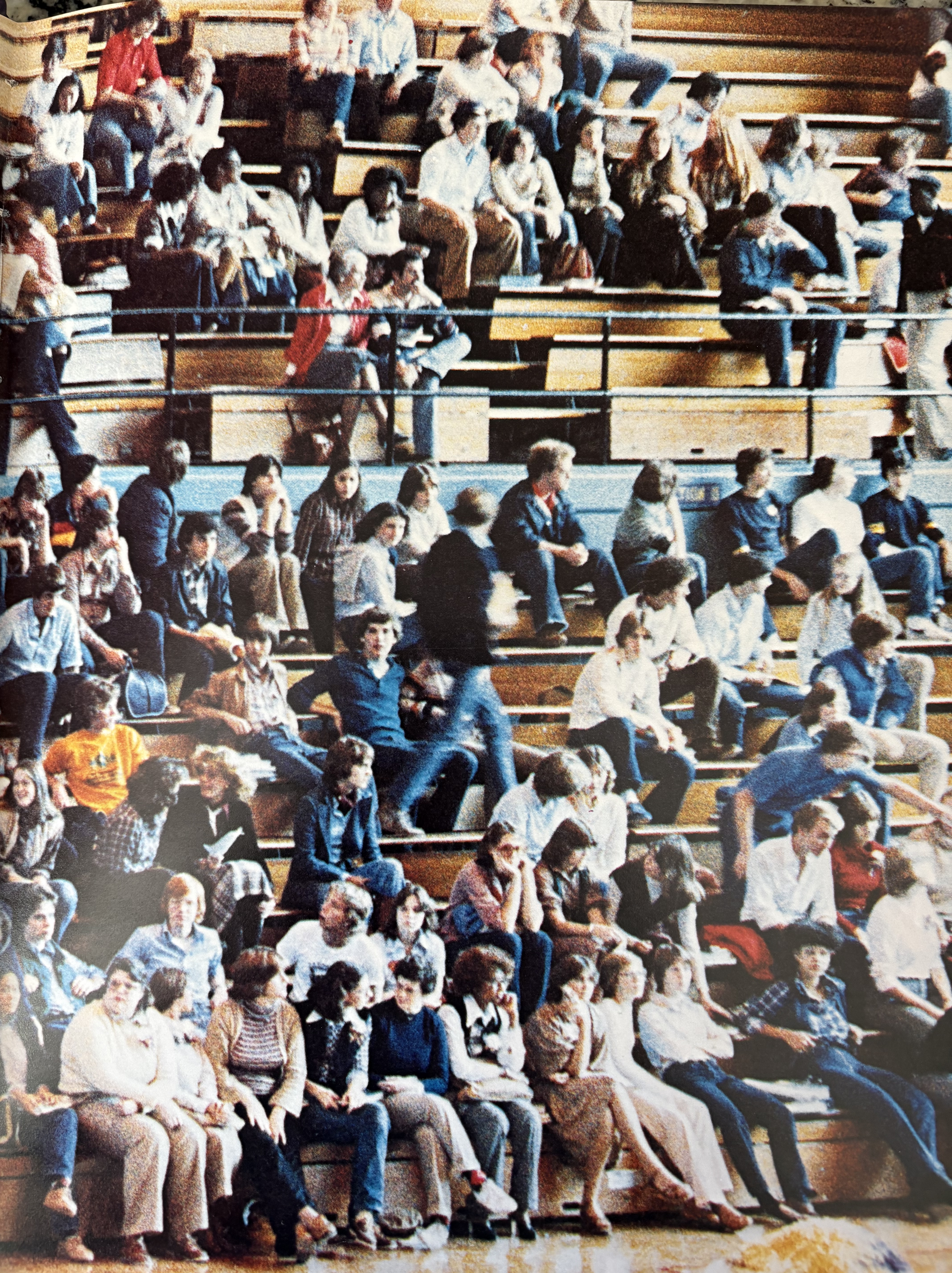
Somehow I made friends. I was never popular, but within a few months, I was rarely alone. In fact, I felt like I was in multiple groups that overlapped in intricate ways. That’s another thing the movies get wrong: at Broughton, the social circles were porous and ever-shifting. I would be friends with someone who had their own friends whom I would then become friends with. And I had friends that those friends would become friends with. It was dynamic: if one group was forbidding, another enfolded you.
Indeed, Broughton was so large, its social world so varied, I’m sure there were whole swaths of people I knew nothing about. Former classmates will read this post and think, “I don’t recognize any of that.” There were kids whom we thought of as rednecks because they smoked during lunch and hung out along the edges of the parking lot. And I’m embarrassed at how racially segregated my world was, at an “integrated” high school in a city that was a quarter Black. I would change that now if I could.
Yet there was one thing we all shared: Broughton itself. It was the center of our world. Its size and energy affected us, even if it didn’t bind us together perfectly. By late fall, I felt part of its swirling ecosystem. And when, in the summer of 1977, I turned 16, got my driver’s license and a job as a dishwasher at a North Raleigh restaurant, my life had turned around.
That first year or two, three people in particular helped me feel at home at Broughton. They were not just friends; they were models of personhood that showed me how one might be in the world – though I wouldn’t have framed it that way at the time.
The first was Scott. I had known Scott at church, but we were not close, and we had never attended the same school before. Scott’s parents were divorced, and he had two houses, his mother’s house in North Raleigh (a house my parents would one day move into, after I left for college) and his father’s, by a pond just outside Raleigh, in the little town of Wake Forest.
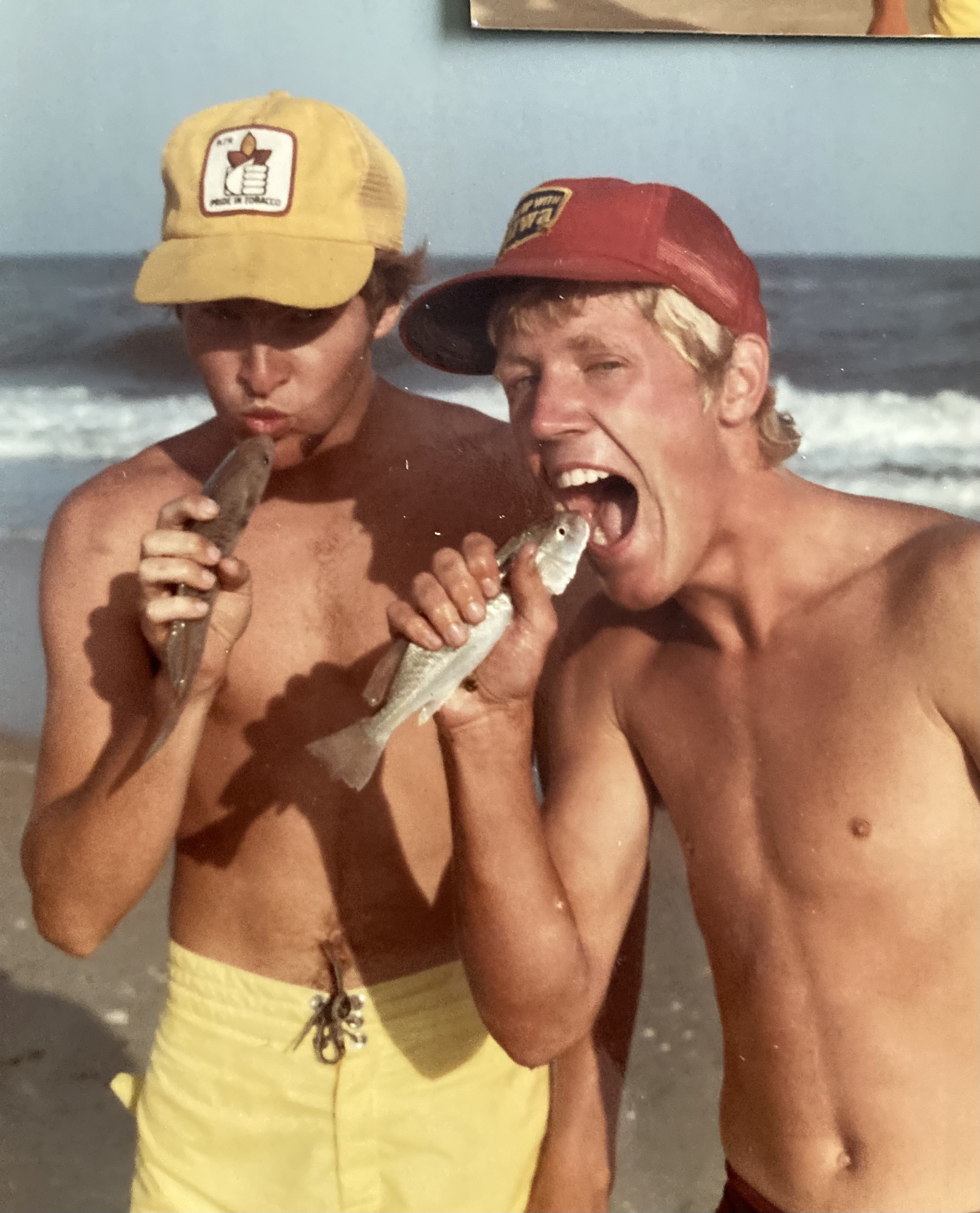
Scott was short with blond hair and slightly goofy. He had an infectiously joyful attitude about everything. He was especially attuned to nature. He ran, skied, camped, fished, boated, hiked – all with ease. He seemed to me preternaturally comfortable in the world. And he combined all that outdoorsiness with an equally passionate love of reading and writing. He showed me how one could be both unselfconsciously in love with the world and eager to express that love to oneself and others. If anyone thought that was corny, or unmanly – Scott could care less.
We must have had English together. And it was there that we bonded over . . . poetry! I don’t know which of us first started reading the poems of Dylan Thomas. I know it was around that time that I started listening to FM radio and got turned on to Bob Dylan, who was said to have named himself after the poet. I loved the song “Like a Rolling Stone,” more than a decade old by then but to me a revelation.
Bob Dylan, “Like a Rolling Stone” (1965)
Once upon a time you dressed so fine
Threw the bums a dime in your prime, didn’t you?
People call say ‘beware doll, you’re bound to fall’
You thought they were all kidding youYou used to laugh about
Everybody that was hanging out
Now you don’t talk so loud
Now you don’t seem so proudAbout having to be scrounging
your next meal
Was it through the music of Bob Dylan that I came to know the poetry of Dylan Thomas? Or was it from the poetry of Dylan Thomas that I came to know the music of Bob Dylan? And how did Scott fit in that picture?
All I know is that at some point we were quoting “Fern Hill” to each other.
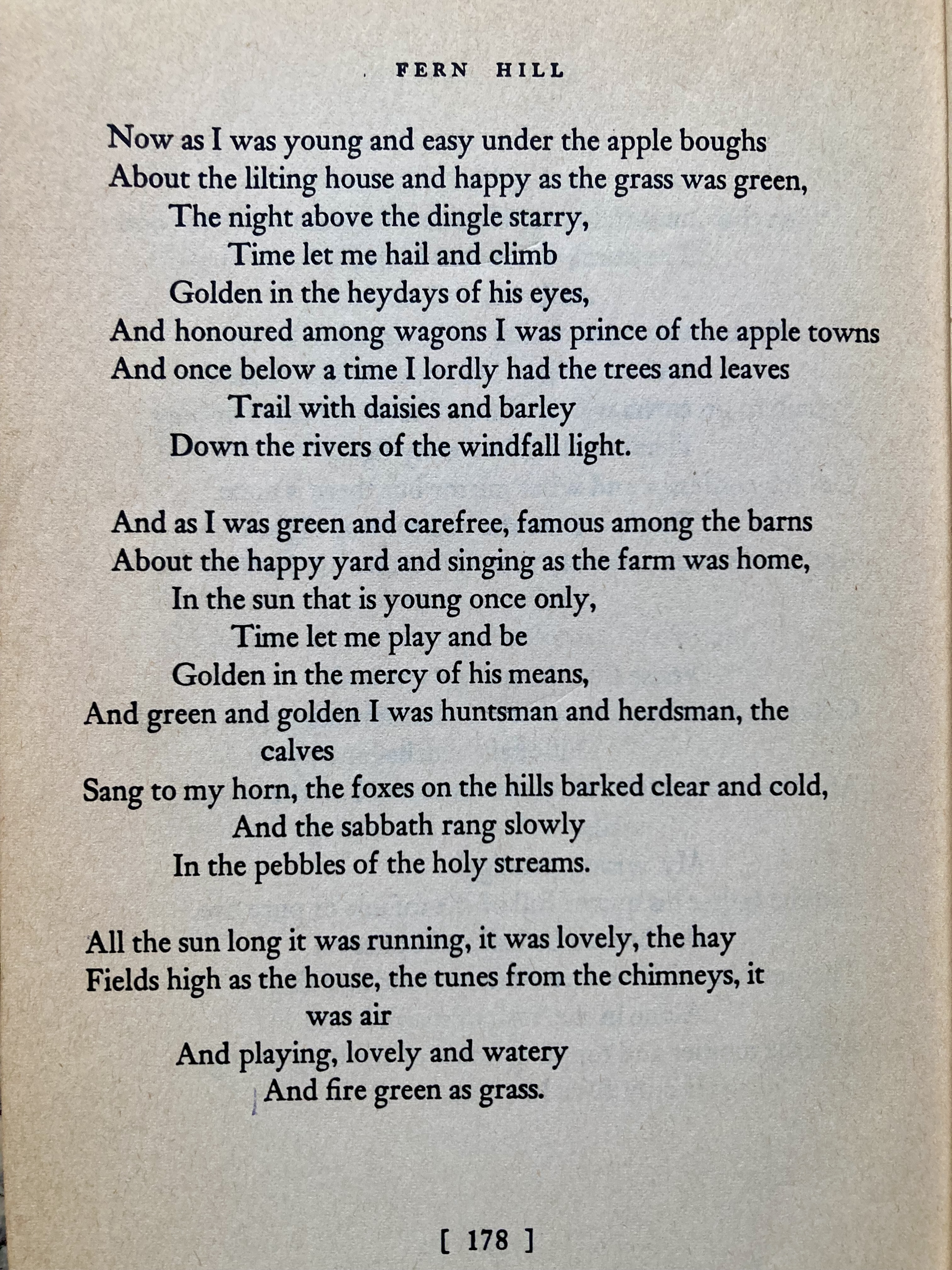
What did we, two teenaged boys in Raleigh, North Carolina, in the mid-1970s, hear in that poem, by a Welsh writer dead a quarter of a century? Was it the sound of youth itself, telling us that the sun would shine forever and the hills roll on without end?
I had not known anyone at Daniels, certainly not a male friend, whom I could quote poetry with.
Then there was Neal. Neal was part of the crowd that had gone to Martin Junior High on Ridge Road, far from “our” part of Raleigh, or so it seemed to me at the time. Many of them were in the band at Martin and so joined the marching band when they got to Broughton, a large, self-contained world of its own. They were gleefully nerdy.
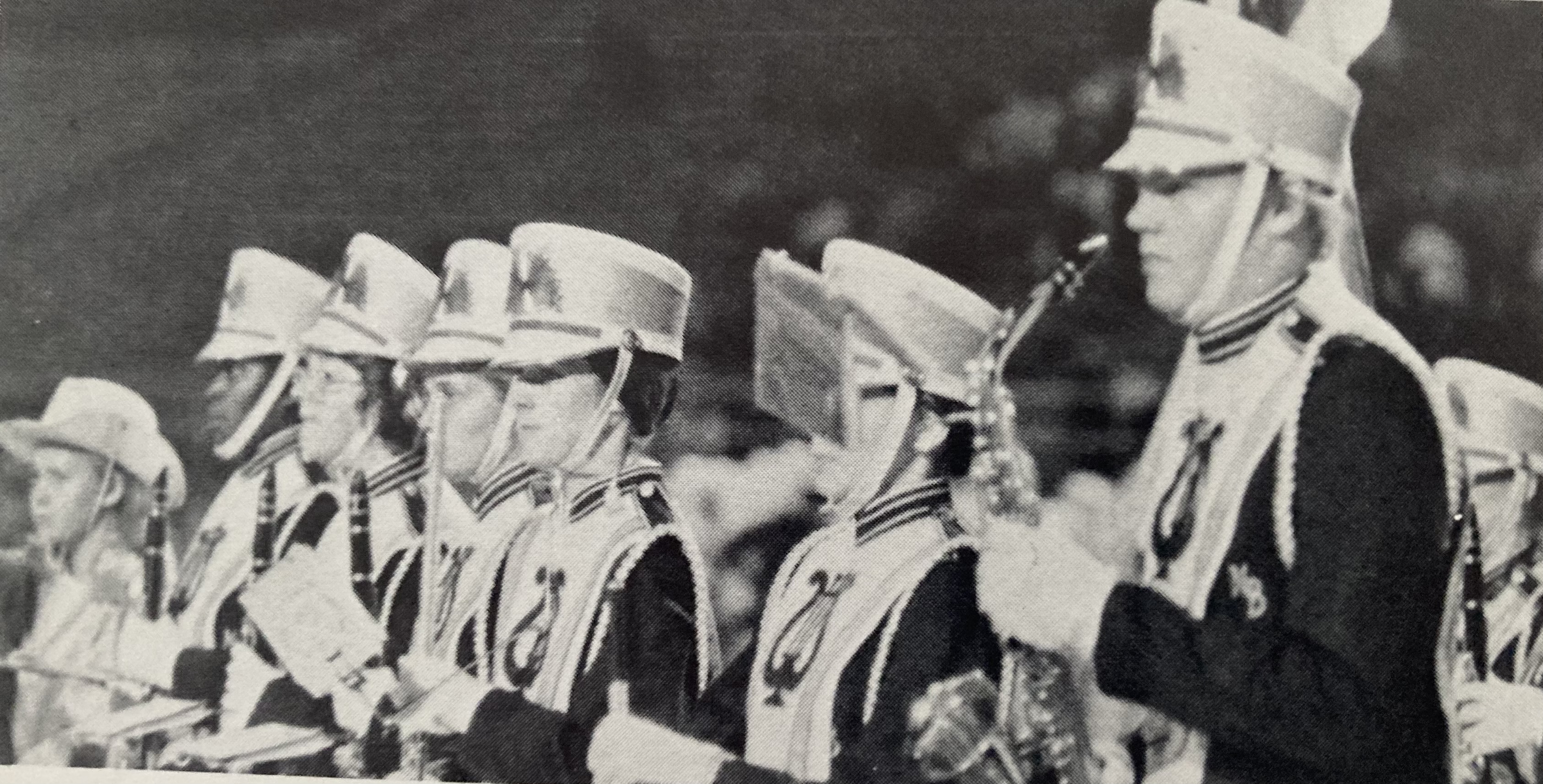
Neal had grown up the only child of a single mother in a small house near a shopping center on Ridge Road. Like Scott, he was open and kind – different from the boys I had known in Country Club Hills, whom I look back on now, perhaps unfairly, as rich and cocky. The Martin crowd didn’t care about where they fit in the social hierarchy.
That attitude must have come at least in part from being in the marching band, where every person played their part, equally as important as every other. Learning your instrument was the least of it. You had to play the instrument while marching in time, often in some intricate pattern, and you had to do that while attending to everyone around you, stepping when they stepped and turning when they turned. It was a strange way to spend your fall afternoons, and yet they seemed to have more fun than any of us.
To this day when I hear a student say they’re in the marching band, I have a positive feeling about them.
Finally, there was Wendy. Wendy and I had known each other at Daniels, but we had not been close. At Broughton, we ended up in sophomore French together, in a trailer parked outside the school to handle the overflow. The trailer was crowded, the teacher a bit ridiculous, and Wendy and I caught each other’s eye. Both of us were laughers – in one of my junior high yearbooks, I had been named “most easily amused” – and once we started laughing, we couldn’t stop. Soon, we were separated, which of course only made it worse.
By that spring we were practically inseparable. We later took German and photography classes together – experiences that bound us further. And soon I became friends with the kids from her neighborhood, Cameron Park, a more unconventional crowd than any I had ever known. They would change my life.
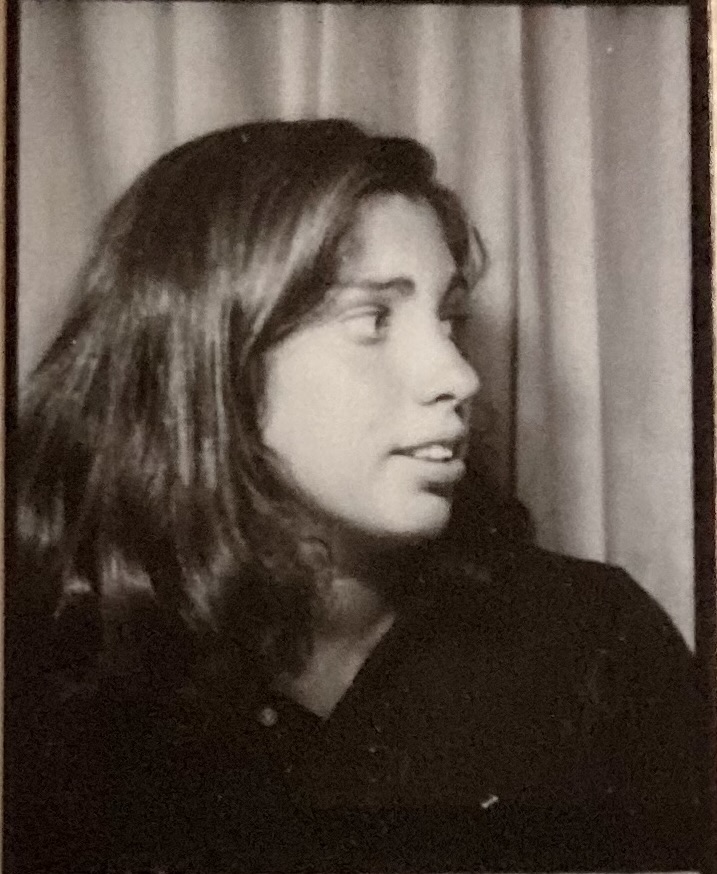
But it was Wendy who was most special to me. I had never been close friends with a girl. I felt like I was seeing the world with new eyes. Like Scott and Neal, she was guileless. And like them, she had a great capacity for wonder. She was also full of sympathy. If she saw someone suffering, she could not move on until she had done something about it. I’ve never known anyone so deeply, reliably honest.
As poetry with Scott and music with Neal, photography was part of my relationship with Wendy. We came to it independently at the same time. I learned to develop film from my older brother Mark, whose hobbies I sometimes inherited when he tired of them. My parents had built us a darkroom in our basement on Transylvania Avenue – with a double door so you could keep the light out, a sink, and a black and white projector. Mark wired in stereo speakers. Even today, there are songs from Simon & Garfunkel’s Greatest Hits that transport me back to that darkroom.
I had a Nikkormat FT2 SLR 35mm camera that I was very proud of. I was never a great photographer, but I loved it. And I learned from Wendy’s talented eye.

But it wasn’t just photography. Wendy opened doors that I didn’t know I wanted to walk through: it was from her that I first began to think about the world beyond North Carolina – places like New York City and Europe, where there were plays to attend, art and architecture to see, streets to walk down, pictures to take. It was through her that I first met people who were dedicating their lives to art.
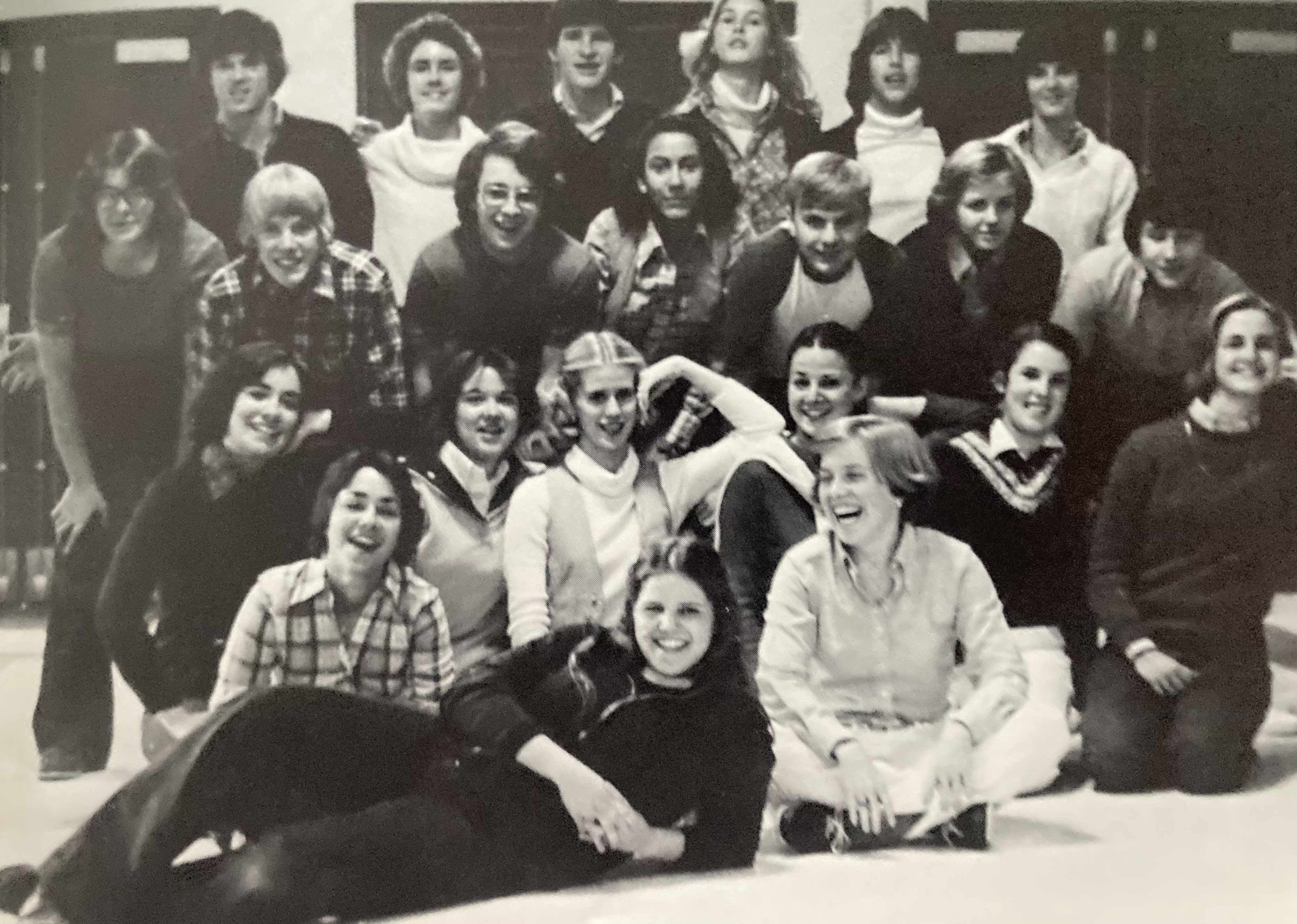
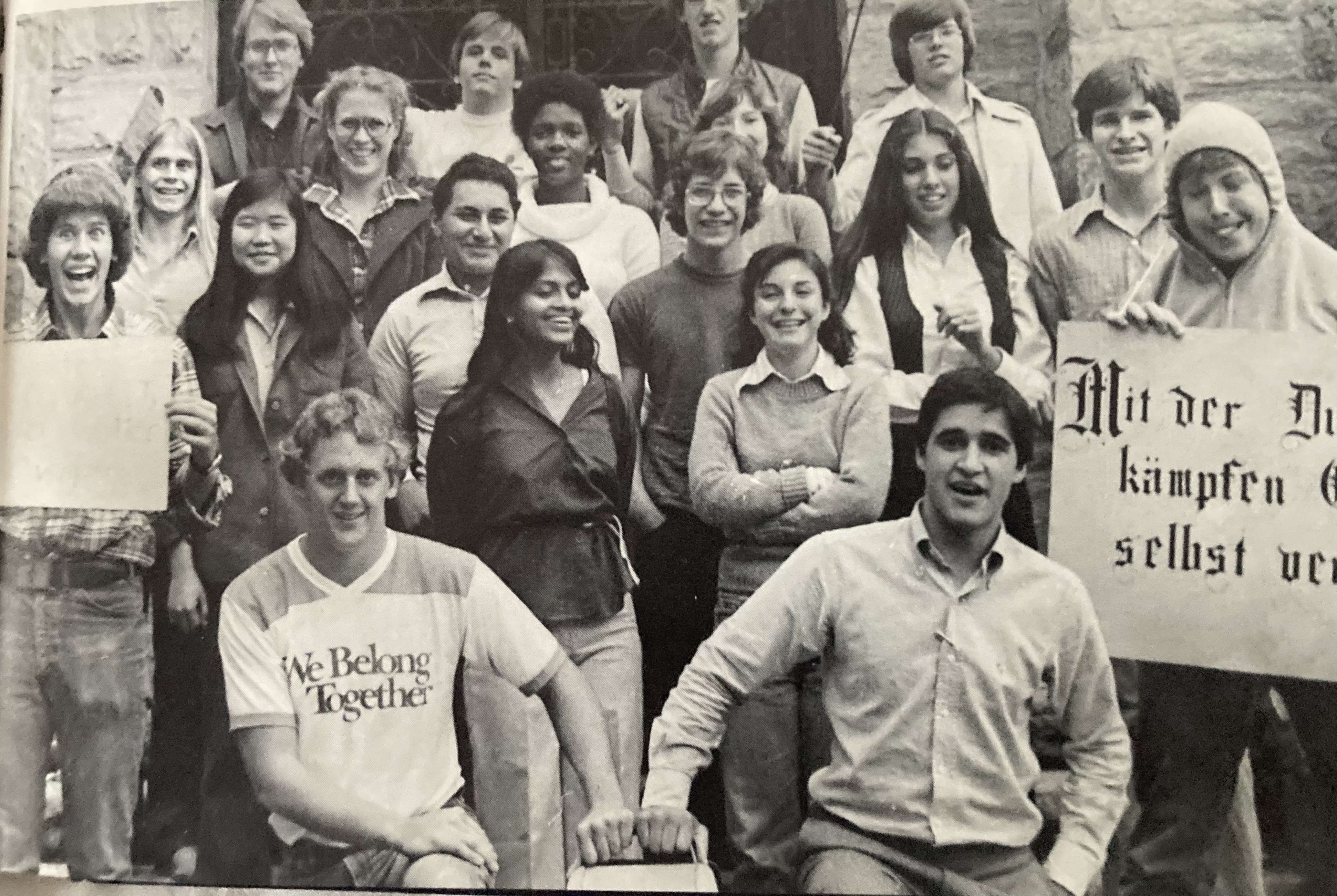
(Life at Broughton was organized around committees, clubs, and after-school activities. Here’s the Publicity Committee, 1978-79: I’m in the back row, Scott in a plaid shirt on the left. And the German Club, 1978-79: Wendy and I are standing in the third row, to the right.)
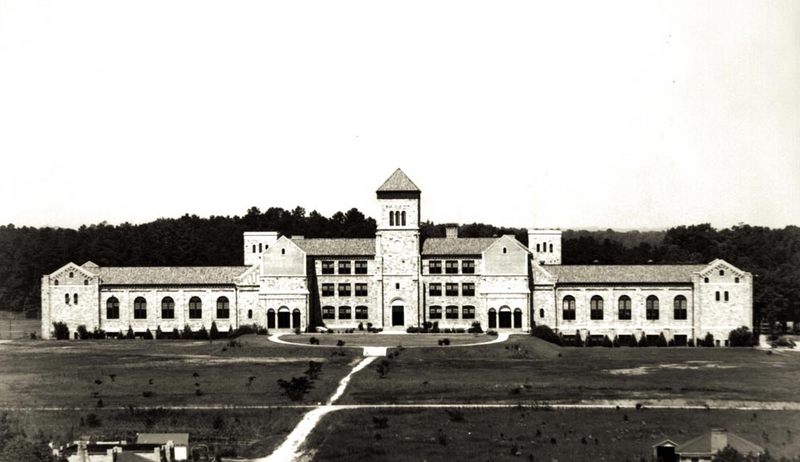
When Broughton opened in 1929, it was known as Raleigh High School. When I was growing up, everyone you met – and their parents – was an alumnus. It was famous for its sports heroes: Pete Maravich played basketball there. And it had long social traditions, like the Queen of Hearts dance, which went back to the early 1940s. The school was, in many ways, the economic and social incubator of postwar Raleigh.
What I didn’t know until later was that Broughton also had a long tradition of excellence in the arts. From the drama department, there was a steady stream of plays and musicals. There was a well-regarded choral group, a lively student newspaper (The Hi-Times), a vibrant literary journal (Winged Words), and a beloved yearbook called Latipac (“capital” spelled backwards). Classrooms had hand-painted murals in them, and the academics were known statewide.
But the school’s real claim to fame was literature. Within the space of a dozen years or so, from the late 1940s to the early 1960s, Broughton produced three of the great American fiction writers of the later twentieth century.
Reynolds Price was born in 1933 in Macon, NC, and grew up in the rural northeastern part of the state. His family moved to Raleigh during his teen years, and he attended Broughton, graduating in 1951. He then went to Duke University on scholarship and was later a Rhodes Scholar at Oxford, returning to Durham and accepting a three-year instructorship at Duke that turned into a 50 year faculty career.
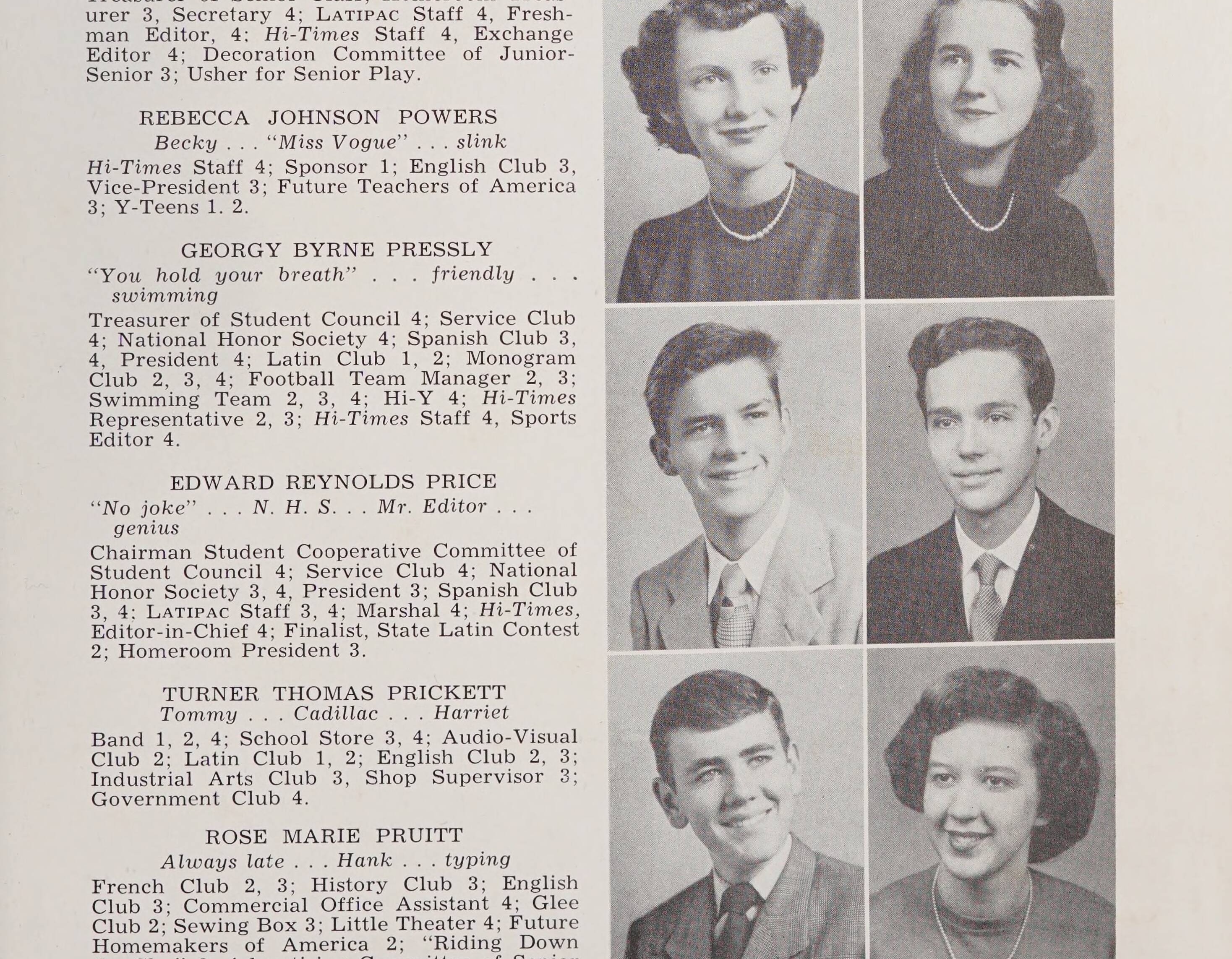
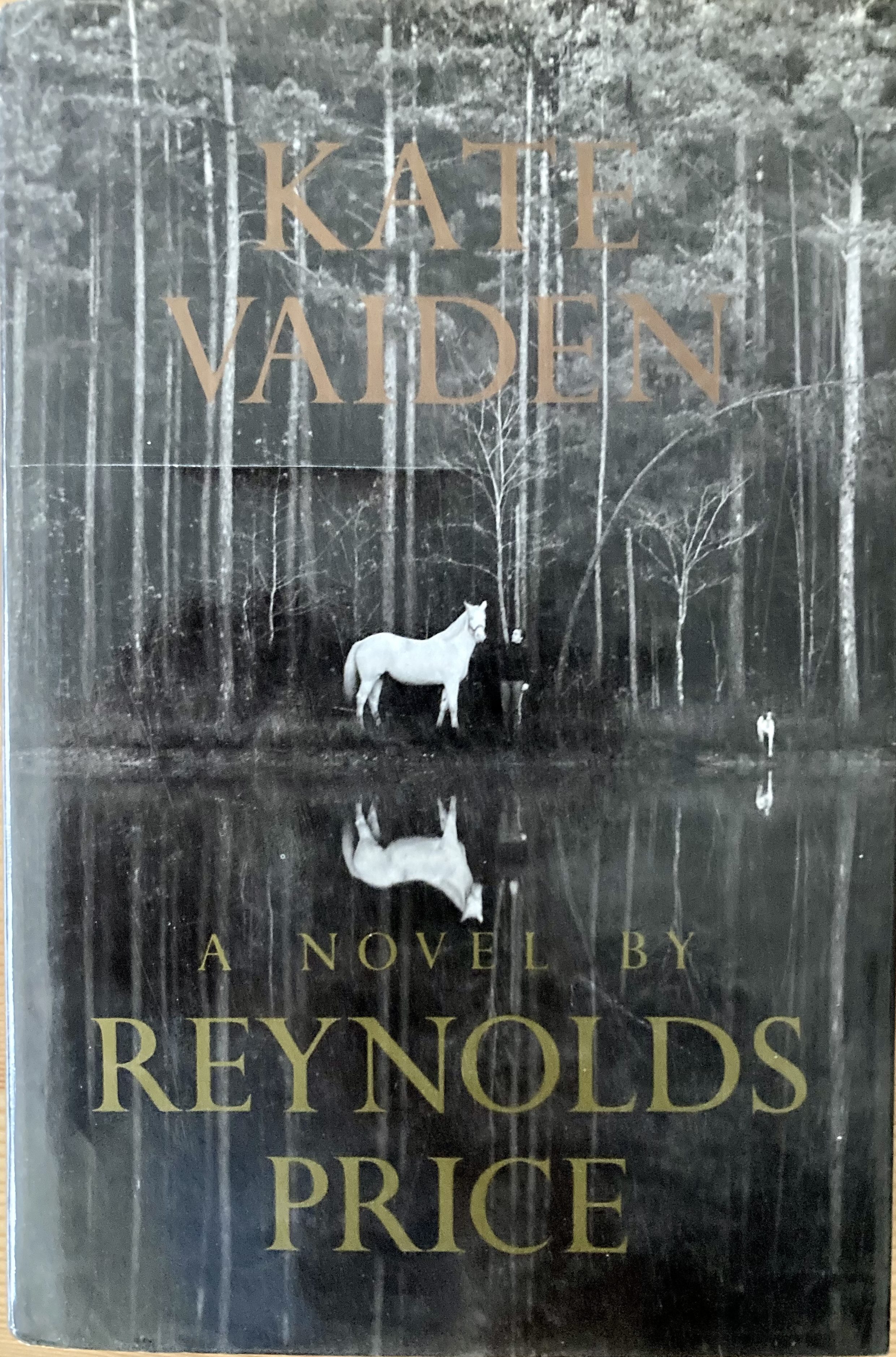
Price published his first novel, A Long and Happy Life, in 1962. My favorite novel of his, Kate Vaiden (1986), won the National Book Critics Circle Award in 1986; I gave it to Nani to read when we moved to North Carolina in 1987. It’s written in the first person from the point of view of a middle-aged Southern woman looking back in time and thinking of her long-lost son, Lee. She begins the story, “The best thing about my life up to here is, nobody believes it.” Reynolds Price died in 2011.
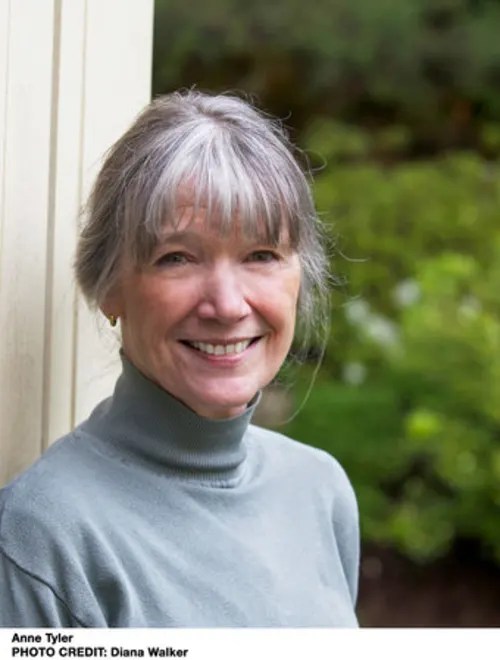
Anne Tyler was born in 1941 in Minneapolis to Quaker parents who moved around the country, looking for communities dedicated to social justice. They lived for a time in Celo, NC, in the mountains. When the family moved to Raleigh in 1952, Anne at 11 had never attended public school before. When she finally did, she was far ahead of the other pupils her age. She graduated from Broughton at age 16 in 1958. She too won a scholarship to Duke where her freshman English instructor was Reynolds Price.
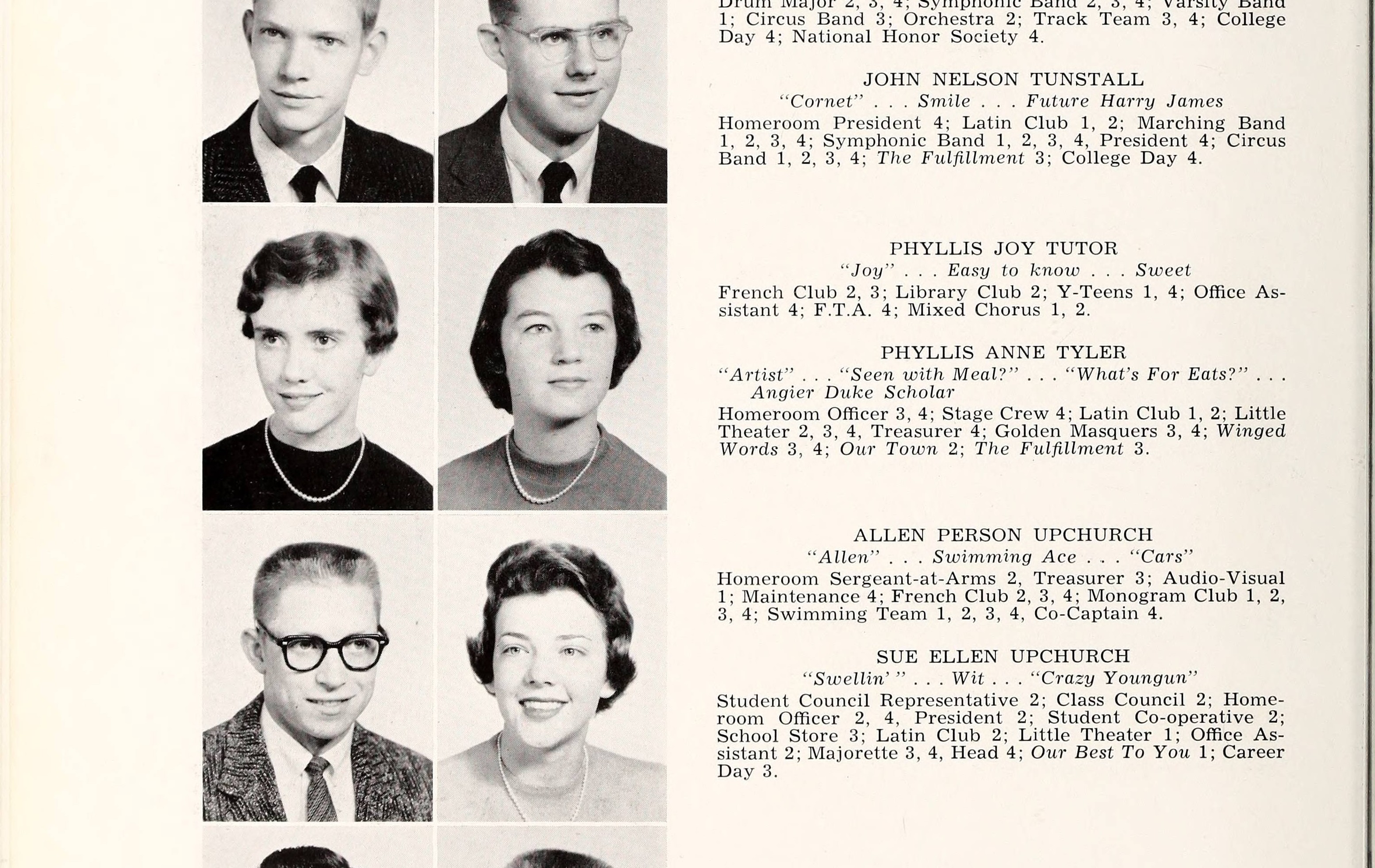
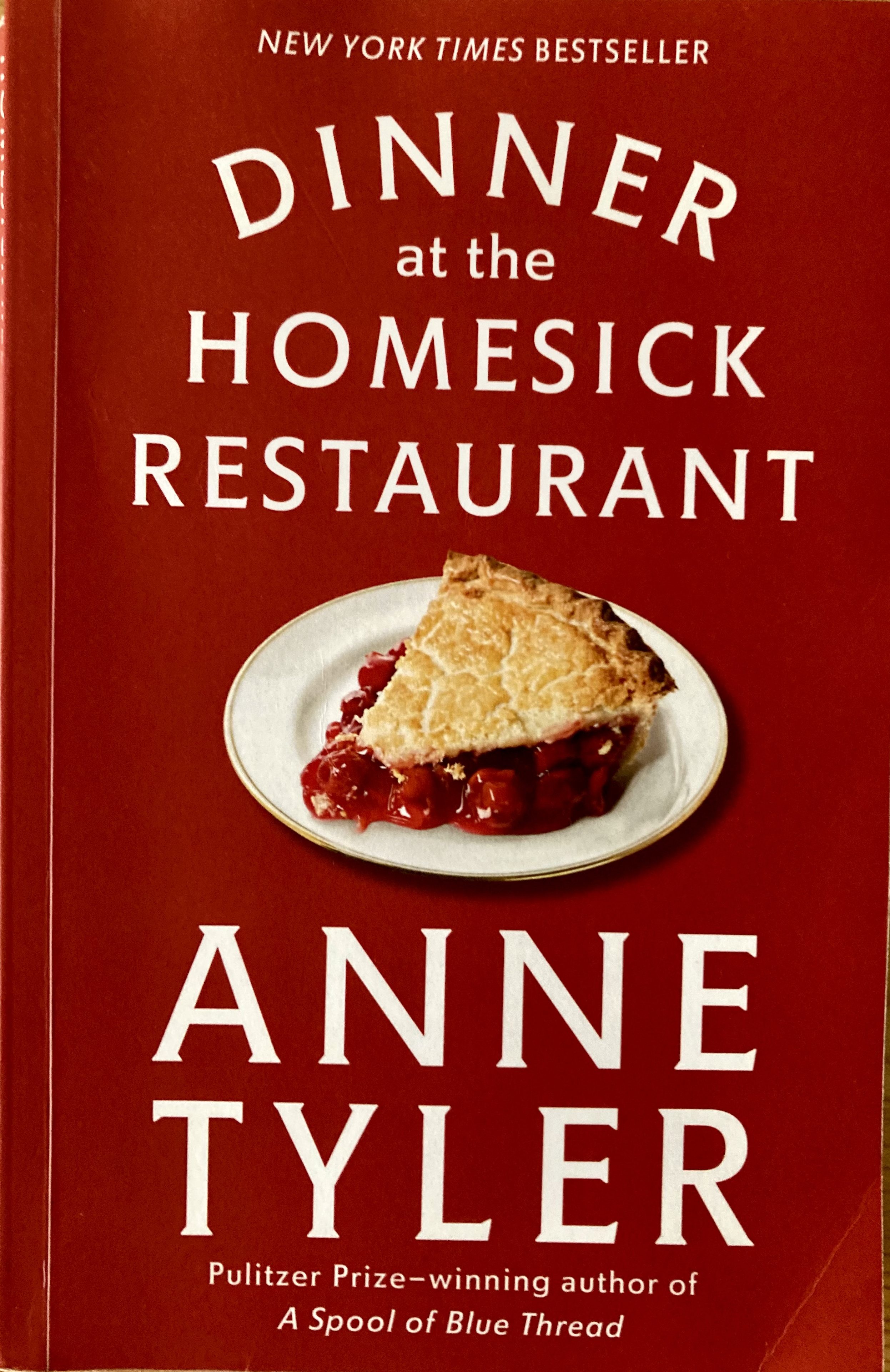
Tyler published her first novel, If Morning Ever Comes, in 1964. When I was teaching English in Kenya in the mid-1980s, a group of us passed around books; one of our favorites was Anne Tyler’s Dinner at the Homesick Restaurant (1982), a novel about three siblings growing up in Baltimore. Its opening line is, “While Pearl Tull was dying, a funny thought occurred to her.” In 1985, Tyler won the National Book Critics Circle Award for The Accidental Tourist, just a year before Reynolds Price won for Kate Vaiden. She lives in Baltimore and is still writing.
Armistead Maupin was born in 1944 in Washington, DC, but raised in Raleigh; his father was a well-known lawyer in town, his great-great-grandfather a Confederate General killed at the Battle of Antietam. He graduated from Broughton in 1962 and attended UNC-Chapel Hill for a time. He served in the U.S. Navy during the Vietnam War and later worked as a journalist in Charleston, SC.
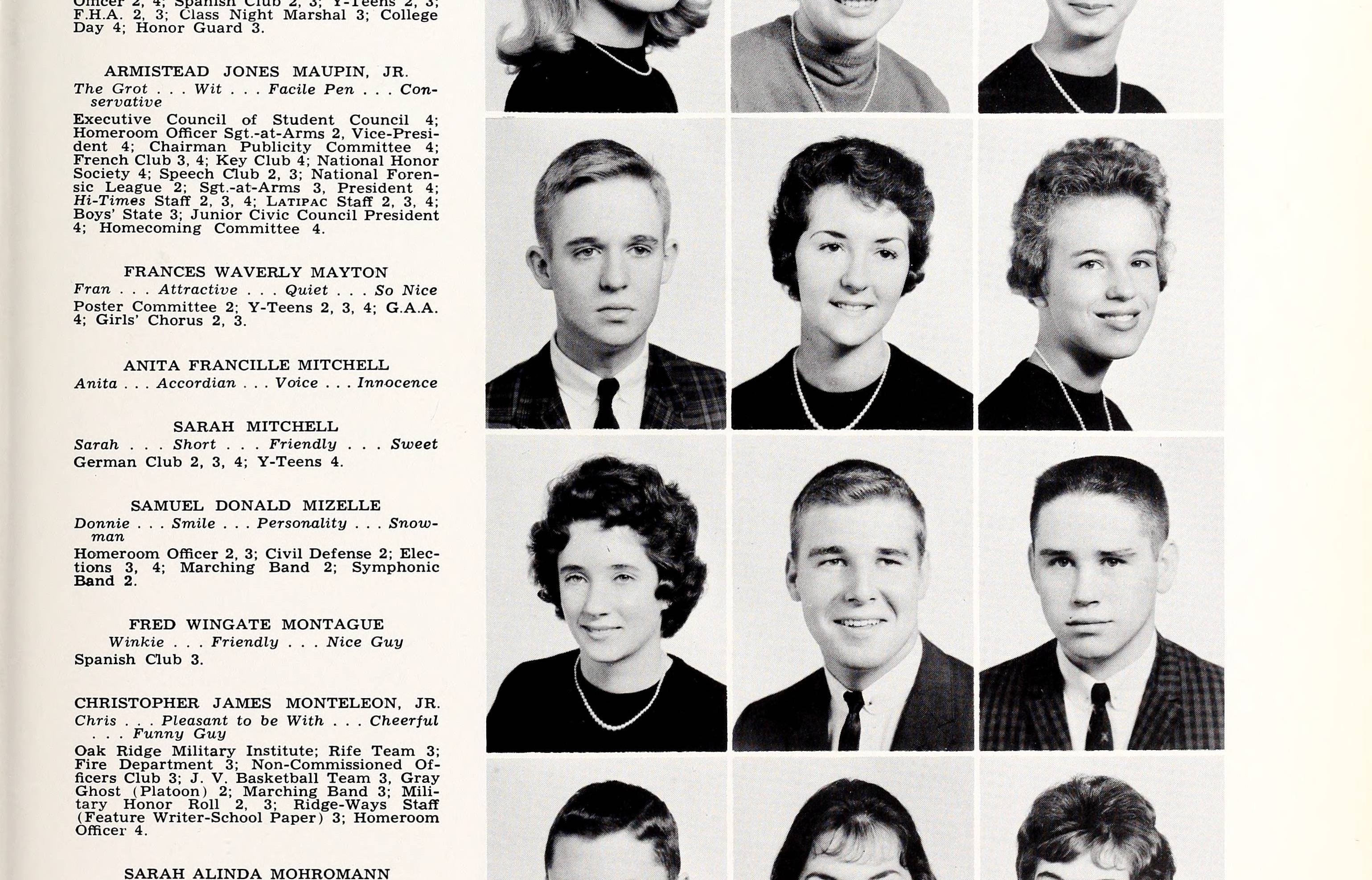
Moving to California, Maupin wrote for a Marin County paper, the Pacific Sun, where he began, in 1974, a weekly serial about a group of San Francisco characters, many of them LGBTQ. In 1976, the column was picked up by the San Francisco Chronicle as “Tales of the City”; the first sentence, on May 24, 1976, was “Mary Ann Singleton was 25 years old when she saw San Francisco for the first time.” Two years later, the “Tales” were published as a novel. Nine more volumes have appeared in the years since, and more than six million copies have been sold. Maupin currently lives in London.
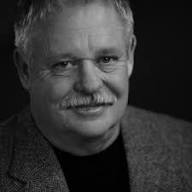
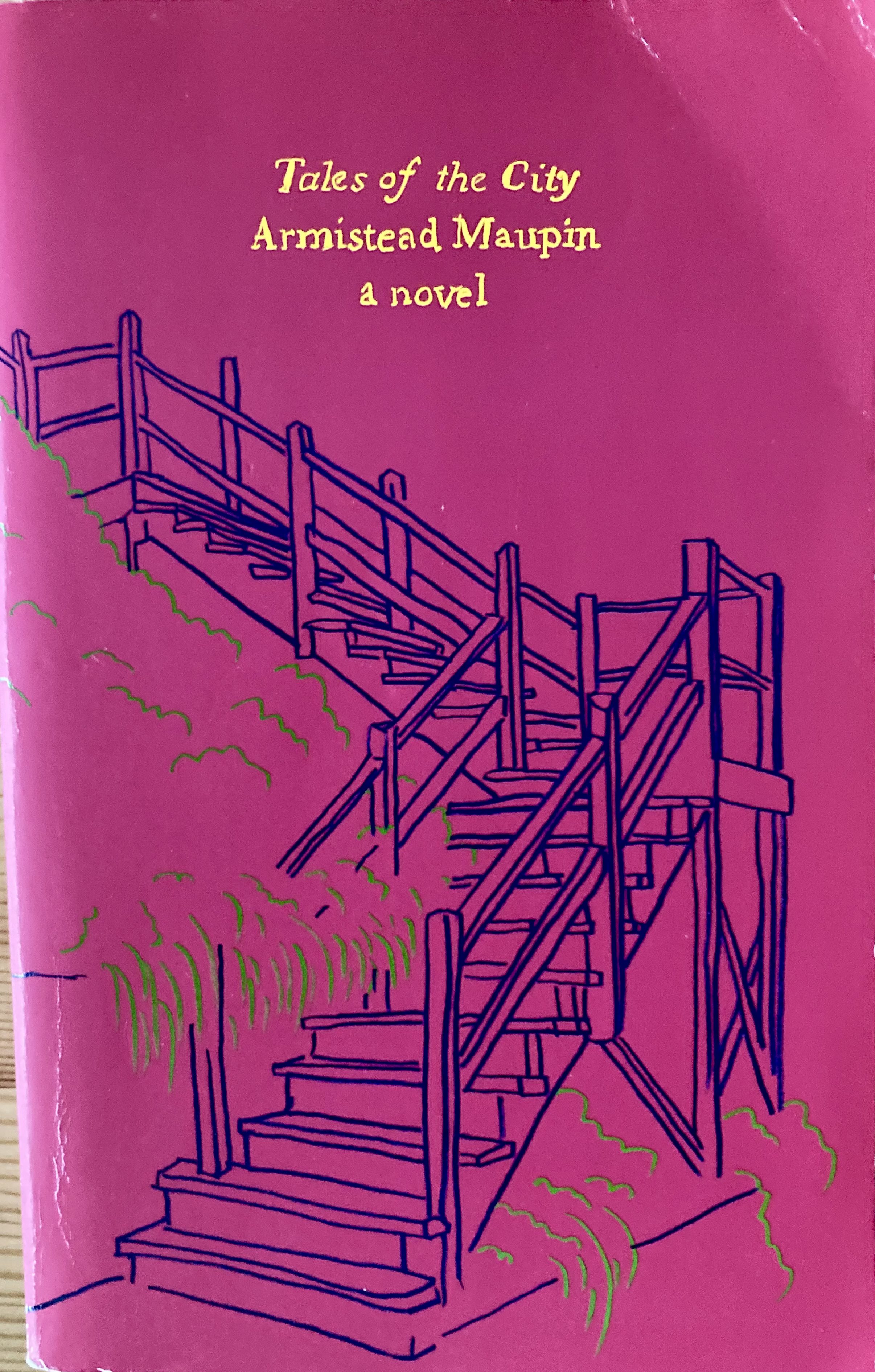
(Latipacs courtesy of DigitalNC; a list of relevant links is provided at the end of this post.)
Reynolds Price, Anne Tyler, and Armistead Maupin were very different people, one from the other, and very different writers, too. No doubt, they had different experiences at Broughton. But they had one thing in common: Phyllis Peacock.
For a quarter of a century, from 1949 to 1975, Mrs. Peacock taught English at Broughton. She would become a legend. In his 2009 memoir, Ardent Spirits, Reynolds Price described her as “my own remarkable English teacher Phyllis Peacock, a woman marked by an outlandish but ultimately irresistible intensity of love for her subject.” Anne Tyler would dedicate her first novel to her: “To Mrs. Peacock, For everything you’ve done.” And Armistead Maupin has written: “But the person who really made a difference to me was Mrs. Phyllis Peacock, who was my senior English teacher. We’ve all had one of those teachers—or if we were lucky, you’ve had one of those teachers—that you remember all your life, and who changed the way you think and work and create.”
What was it about Phyllis Peacock that so resonated? All three authors featured above wrote of her passion, not just for literature but for helping young people discover it. Former students have described her reciting Shakespeare, standing on a chair, the class transfixed. In a 1992 article in the Charlotte Observer, one former student said of her, “She was the best teacher I’ve ever had. Literature for her was not an academic thing, it was a way of forming character.”
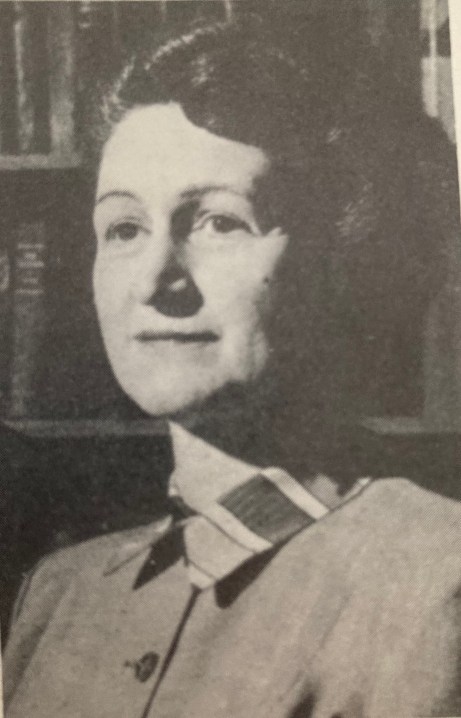
When Mrs. Peacock read something from you that she liked, she would write in the margins, “Orchids to you!”
The nurturing of great writers, of course, is not reducible to a single thing. Reynolds Price, Anne Tyler, and Armistead Maupin all had family backgrounds that contributed to their personalities and craft, and they were all fortunate, in different ways, in their experiences after Broughton. But clearly something about the school, and its people, stayed with them.
That’s not to say Broughton was a paradise. Before 1971, as we’ve seen, Raleigh’s public schools were rigidly, brutally, racially segregated; and even after 1971, as my own experience attests, they remained informally racially segregated in numerous, terrible ways. It was a cruel system that distorted everyone involved in it.
And surely those writers had, like all of us, mixed experiences in high school, regardless of the social conditions “outside.” Price and Maupin were both gay, if not “out” at the time. Maupin has described himself as a “wallflower” at Broughton, and Tyler has written of feeling like an outsider there. Mrs. Peacock’s magic, after all, was not omnipotent.
Oddly, I don’t recall hearing about the three when I was at Broughton in the late 1970s. Mrs. Peacock had retired several years before, although Price, Tyler, and Maupin were all active, publishing writers when I was there. The fact is, I came to them later in life, in each case by seeming happenstance and always with a bit of a shock on learning that they had gone to my high school.
Still, something must have remained of that era when I was there. All around me were creative types: musicians, dancers, actors, artists, writers. Truth be told, there was probably no more talent at Broughton in the late 1970s than there was at any comparably sized public high school anywhere in the country. And yet . . . the place felt special to me.
Mrs. Peacock died in 1998; she was living at Springmoor Retirement Center in North Raleigh, where my parents would die a year apart, in 2022 and 2023, a quarter century later. My own English teacher, Mrs. Wooten, died at Springmoor in 2012. I later discovered that she had gone to the same little college, in Louisburg, NC, as my grandmother and that she had married a man named Fleming after she retired from teaching.
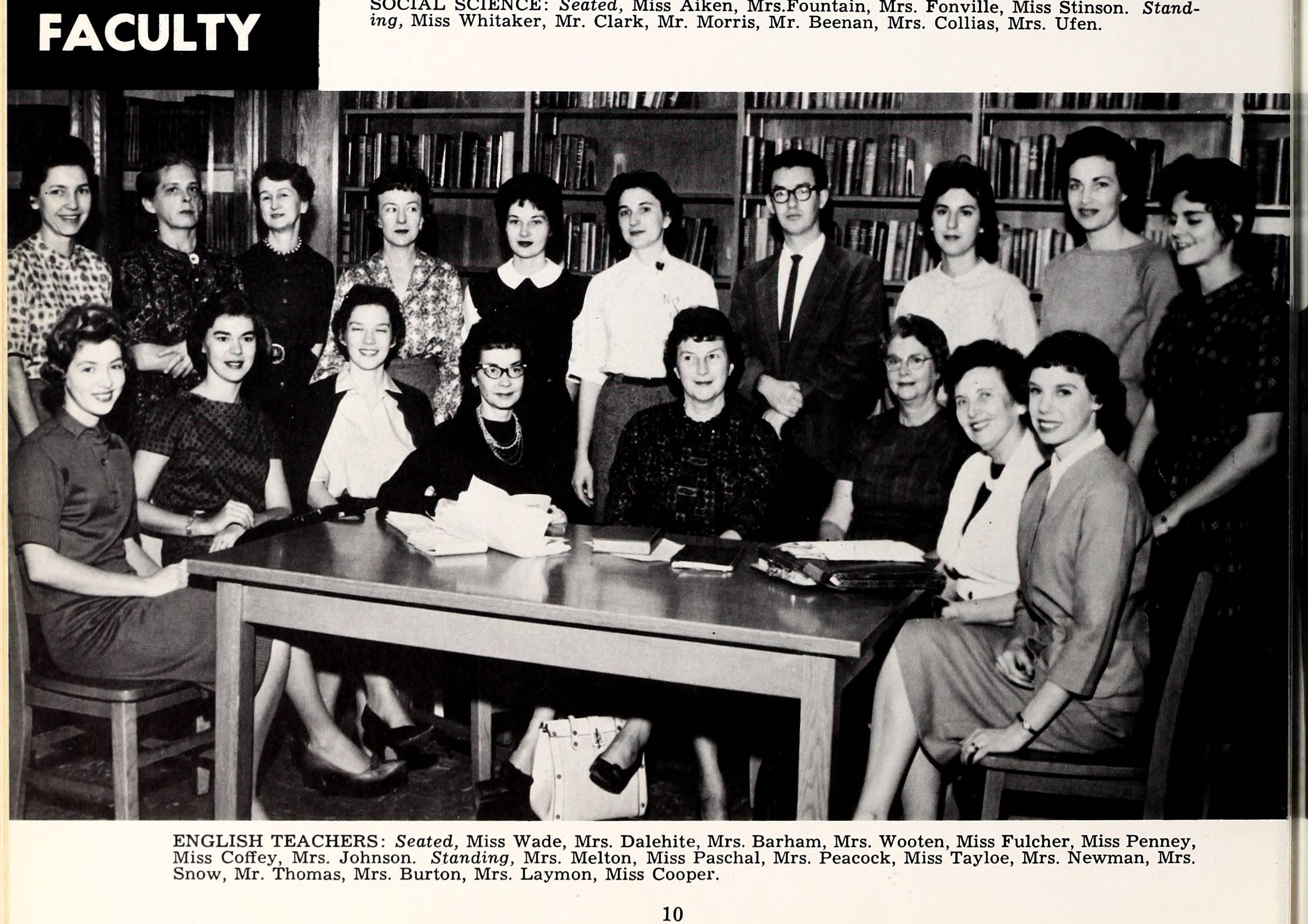
You can see both Phyllis Peacock and Margaret Wooten in the photo above, from 1962, the year Armistead Maupin graduated. Mrs. Peacock looks regal in the back row, third from left. My future teacher, Mrs. Wooten, is sitting in the first row, fourth from left, in glasses, looking a bit more sly, which accords with my memory of her. She was no Phyllis Peacock, but we loved her, and she was devoted to us. Like Mrs. Peacock, she was unabashed in her love of literature; and she was unstinting, as Phyllis Peacock had been, when you let her down. “You oafs,” she would complain of us.
Philip Watts, the German teacher that Wendy and I were so devoted to, was like that, too. I disappointed him one day for some reason, and, as a penalty, I had to memorize Wordsworth’s sonnet “Composed upon Westminster Bridge, September 3, 1802” and recite it, in class, the next day. The poem has stuck with me ever since: the city, “like a garment . . . bright and glittering in the smokeless air.”
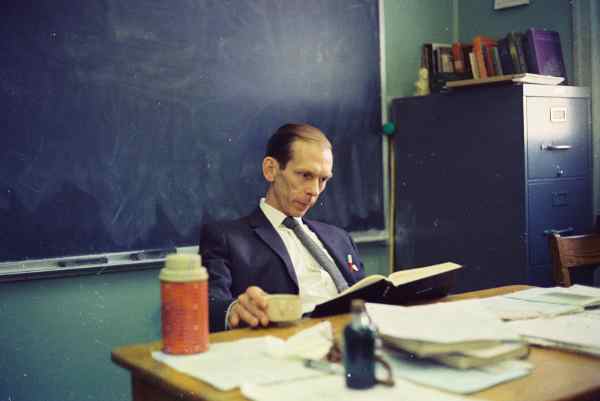
Herr Watts – we thought he was from a different time and place. How strange to realize now that, like Margaret Wooten, like Reynolds Price – like my own father! – he was once just a kid from a small town in rural North Carolina, a crossroads in the middle of nowhere. What Raleigh must have meant to them all!
The neighborhood next to Broughton was called Cameron Park (now Forest Park – like other Raleigh landmarks I’ve mentioned here, Daniels Junior High and Cameron Village Shopping Center, its namesake was either an enslaver of human beings before the Civil War or a white supremacist after). I have written elsewhere about this neighborhood, one of Raleigh’s first suburbs, laid out in 1910 and connected to downtown by an electric streetcar line.
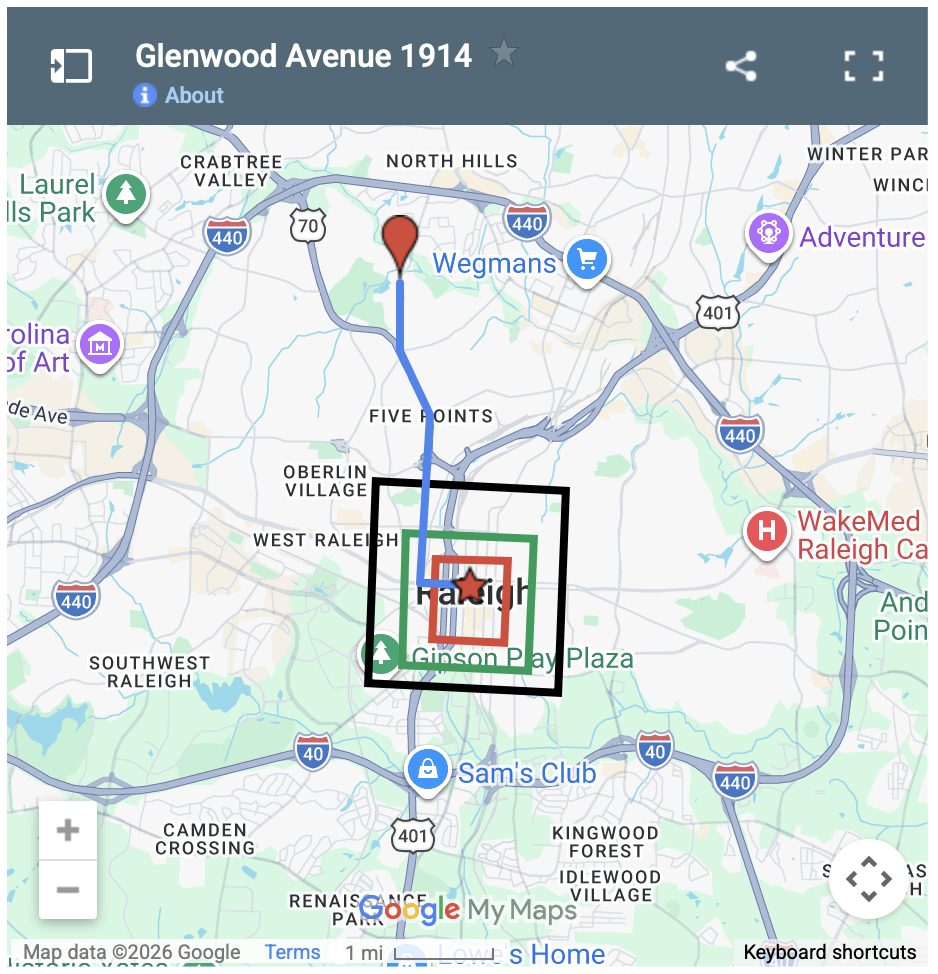
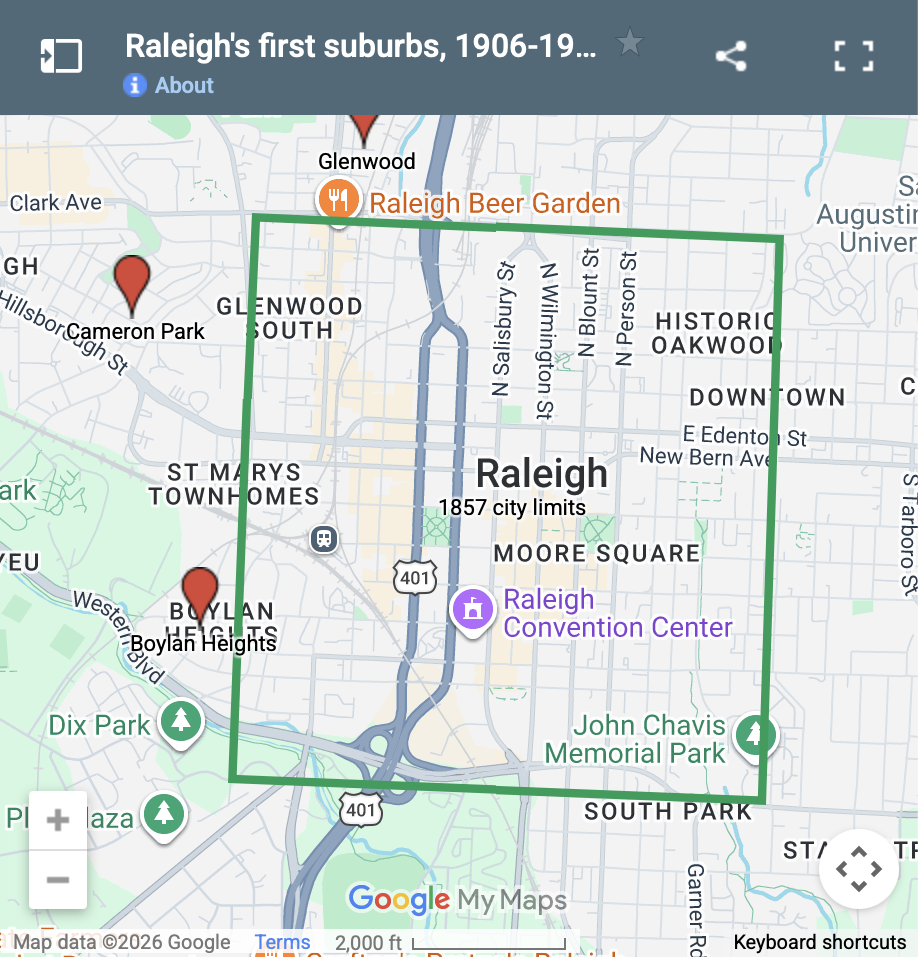
For that earlier post, I created a map of Raleigh showing its 1792 (red), 1857 (green), and 1907 (black) city limits and, in blue, the Glenwood Avenue streetcar line (1906), which ran north from downtown to an amusement park, Bloomsbury, then far outside Raleigh’s city limits, eventually the part of town where I grew up. The other map shows Raleigh’s first streetcar suburbs, including Cameron Park in the top left, in relation to the 1857 (green) city limits.
As I indicated above, I was a North Raleigh kid. Both my parents had gone to college near downtown, at institutions on opposite sides of Hillsborough Street. They met in 1951 at a Baptist church on Capitol Square. Although they spent years away from Raleigh while my father completed his medical training, in 1964 they came back, with four children, and thenceforth our life traced Raleigh’s own movement away from downtown. The city had long been the retail hub of eastern North Carolina, but with the streetcar and then the automobile, the shopping centers gradually moved north. Cameron Village opened in 1949, North Hills in 1967, Crabtree Valley in 1972. They were all automobile-dependent, and each one was a bigger hit than the one before.
In 1976 – that bicentennial year! – Raleigh tried to revitalize its downtown by turning Fayetteville Street into a pedestrian mall. But it was too late.
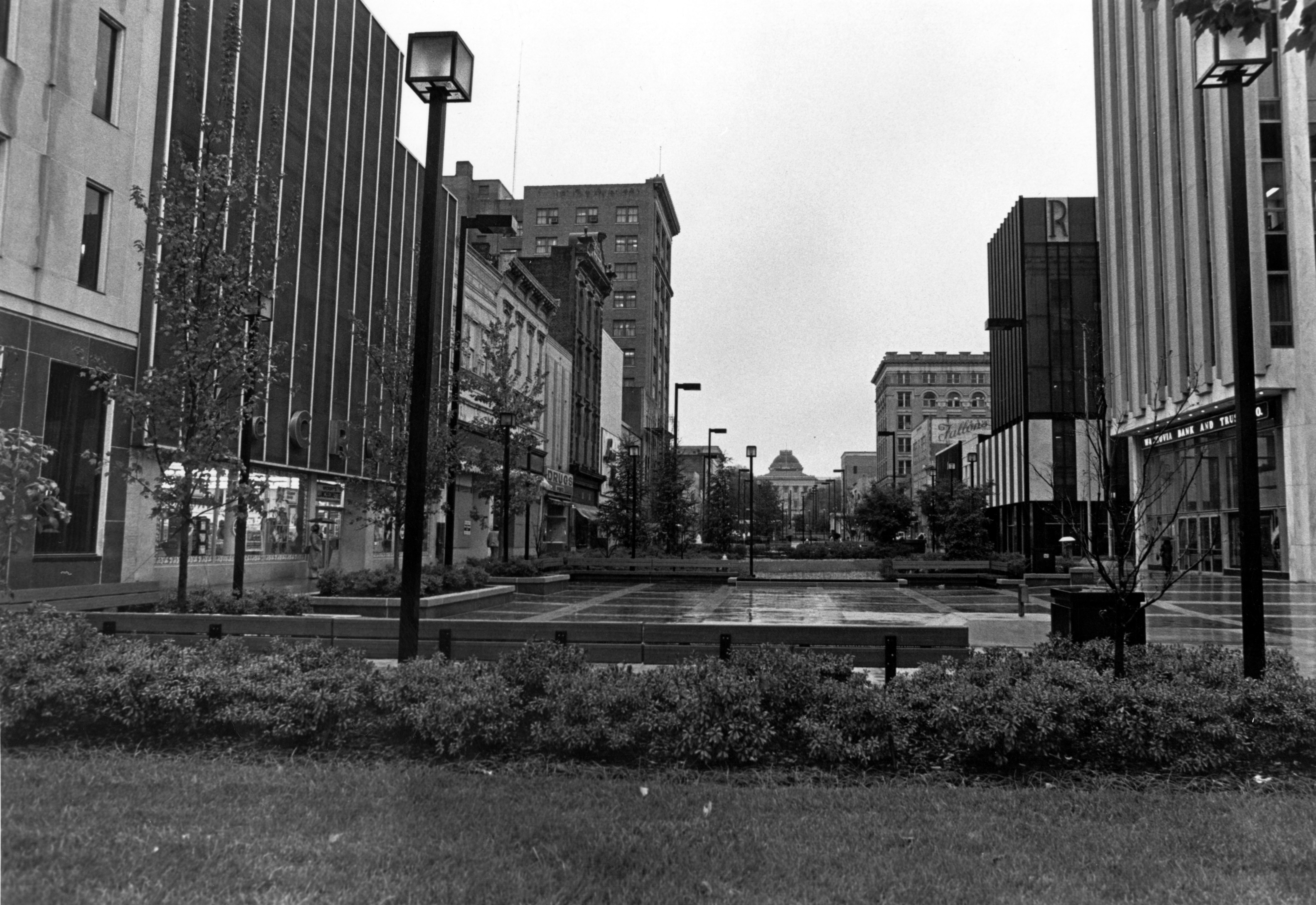
That said, in the 1960s and ‘70s, Raleigh’s downtown and old, close-in suburbs had two things going for them: the city was the capital of North Carolina and thus home to its state government, and it was a vibrant center of higher education, home to the fast-growing North Carolina State University, three women’s colleges, Meredith, St. Mary’s, and Peace, and two HBCUs, Shaw and St. Augustine. The heart of “student” Raleigh was Hillsborough Street, which ran right by Cameron Park.
Indeed, by the 1970s, Cameron Park no longer looked east, towards downtown along the old streetcar line; it now looked west, along Hillsborough Street, toward NC State, which, though less prestigious than Duke or UNC-CH, had well-regarded agriculture, engineering, textile, and design schools. Many of its faculty members lived in Cameron Park. They were from all over the country, giving central Raleigh at that time a surprisingly cosmopolitan feel.
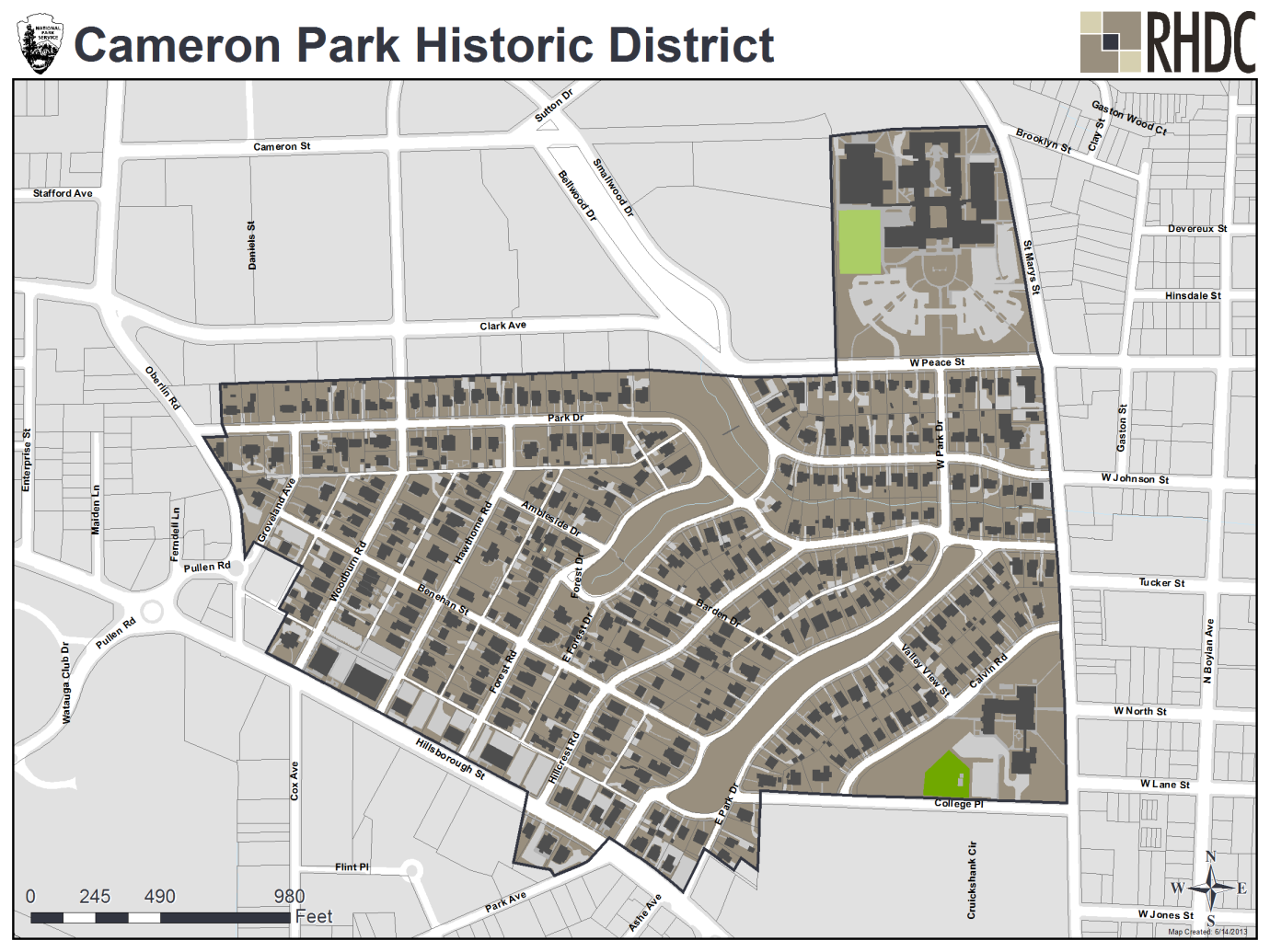
But, for me, Cameron Park was above all Wendy’s neighborhood. As I got to know her, I got to know her family and friends and her friends’ families. The parents, many of them divorced, were professors, artists, designers, and architects. They were all about the same age as my parents, but they seemed from a different generation altogether. Their houses were full not of wooden antiques and pewter serving dishes, like mine, but of modern furniture, white with clean lines, and colorful Scandinavian fabrics. In the kitchens, there were food processors, pasta machines, and olive oil. People talked about New York City like it was next door.
Other Cameron Park kids included Wendy’s friend Brent, whose stepfather was a well-known artist, and her stepsister Melissa, whose father was an architect. Melissa herself was a budding designer. When she went to Europe one summer, she returned with a notebook of sketches that we all thought worthy of publication.
I spent more and more time in Cameron Park. Once I got my driver’s license in the summer of 1977, I was able to visit my friends whenever I wanted, driving the light blue VW bug that my siblings and I used. After school, on weekday afternoons, I would drive over to Ridge Road or Cameron Park, sometimes both. On Friday and Saturday nights, we would go down to Hillsborough Street and eat pizza at Brothers or Two Guys.
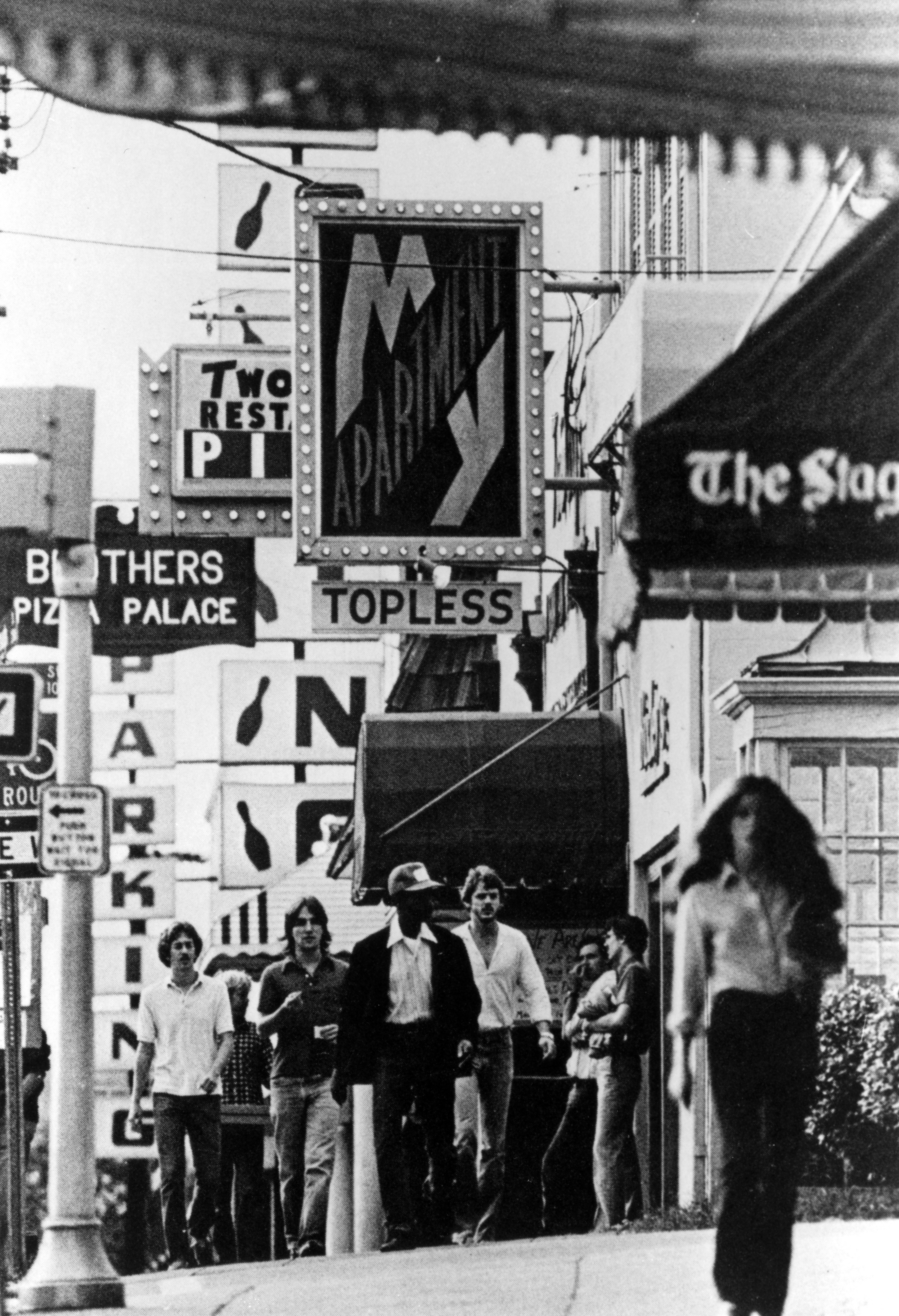
The fact is, if, in the 1970s, Raleigh’s (white) population was moving north, escaping its old downtown, its multiracial past, the seediness of Hillsborough Street, as teenagers, we were looking in the opposite direction, toward the center of the city, the old streetcar suburbs around it, and the college thoroughfare that connected them.
It was music that gradually became the center of my life at Broughton. This was deeply ironic because, if I thought I might have had a spark of talent as a writer, and if I felt like I was growing as a photographer, I had almost no skill as a musician. My turn in that direction was entirely because of the people I was hanging out with.
Nearly all my new friends at Broughton were musical. There were the marching band kids from Martin, with their saxophones and clarinets. There was Jim, an award-winning pianist whose family lived in Oakwood, and Sharon, a singer who blew us away with her voice. The two of them had a band, Slow Children, with Brent, his brother David, a talented bassist, and another friend, Rick, who played drums. They rehearsed in Brent and David’s basement, and, at lunchtime assemblies at Broughton, they played songs by Crosby Stills and Nash and the Doobie Brothers. I couldn’t believe I had friends in a band!
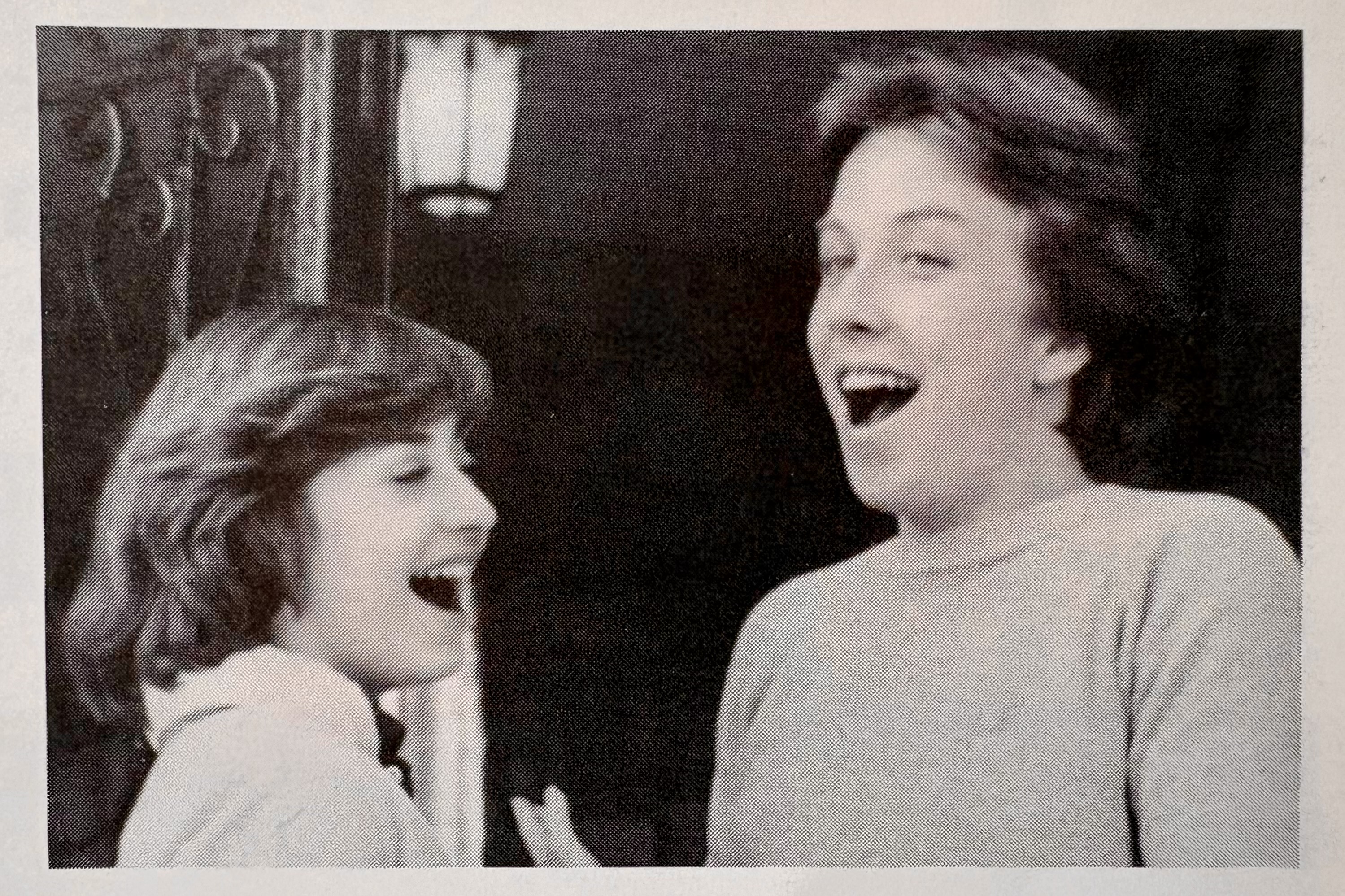
The one with the most astonishing talent was Brent. He sang and played guitar. He wrote songs. And he had an encyclopedic memory of lyrics. He was also fearless as a performer. And he was LOUD. If you asked him, he would sing any song you wanted, every verse, at the top of his voice, in a school hallway, in the middle of the day. (He was often, in my memory, in trouble with one authority figure or other.)
My desire to keep up with my friends musically led to a painfully embarrassing episode in the summer of 1978, after my junior year at Broughton. I had by then formed the ambition to be in the Broughton Chorus, or Ensemble, the highest singing group at the school, led by the formidable Judith Freeman. Most of my friends were in it. It was highly competitive, though chances were better for boys. There was one problem: I couldn’t sing.
The only way to join the Chorus was to audition in front of Mrs. Freeman in the weeks before school started. The whole thing was terrifying to me, but, step by step, I made it happen. I chose a pop ballad then on the radio and purchased the sheet music for it. I then called my old friend Tommy, an accomplished pianist, at home that summer from prep school, and asked if he would accompany me. Then one afternoon late that summer I went to his house to practice.
I gave Tommy the sheet music. I could tell he was amused by my choice, but he gamefully picked out the notes of the introduction, waiting for me to enter. I couldn’t do it. He played the intro again. I couldn’t do it. This went on for several minutes. Finally, when a small, alien sound came out of my mouth, Tommy began laughing so hard he had to stop playing altogether. He apologized, said it was the built-up tension. After we tried again several times, he looked at me and said, “We need a better song.” From the kitchen, his mother – humiliation was now stacked on top of humiliation – yelled a suggestion. We settled on a show tune. I was awful at that, too, but at least it was more suitable for my voice (such as it was).
Later that week we went down to Broughton to audition in front of Mrs. Freeman. She salivated when she heard Tommy’s piano playing. Meanwhile, she put her hands on my diaphragm and gave me a lecture on everything I was doing wrong. Somehow, I got through. But when I finished, the first thing she did was turn to Tommy and ask, was he a rising senior, too? Had he ever served as an accompanist? When he told her he didn’t even go to the school, you could see her disappointment. Still, she said, I was in, hinting at what I already knew: she needed boys. I was just glad it was over.
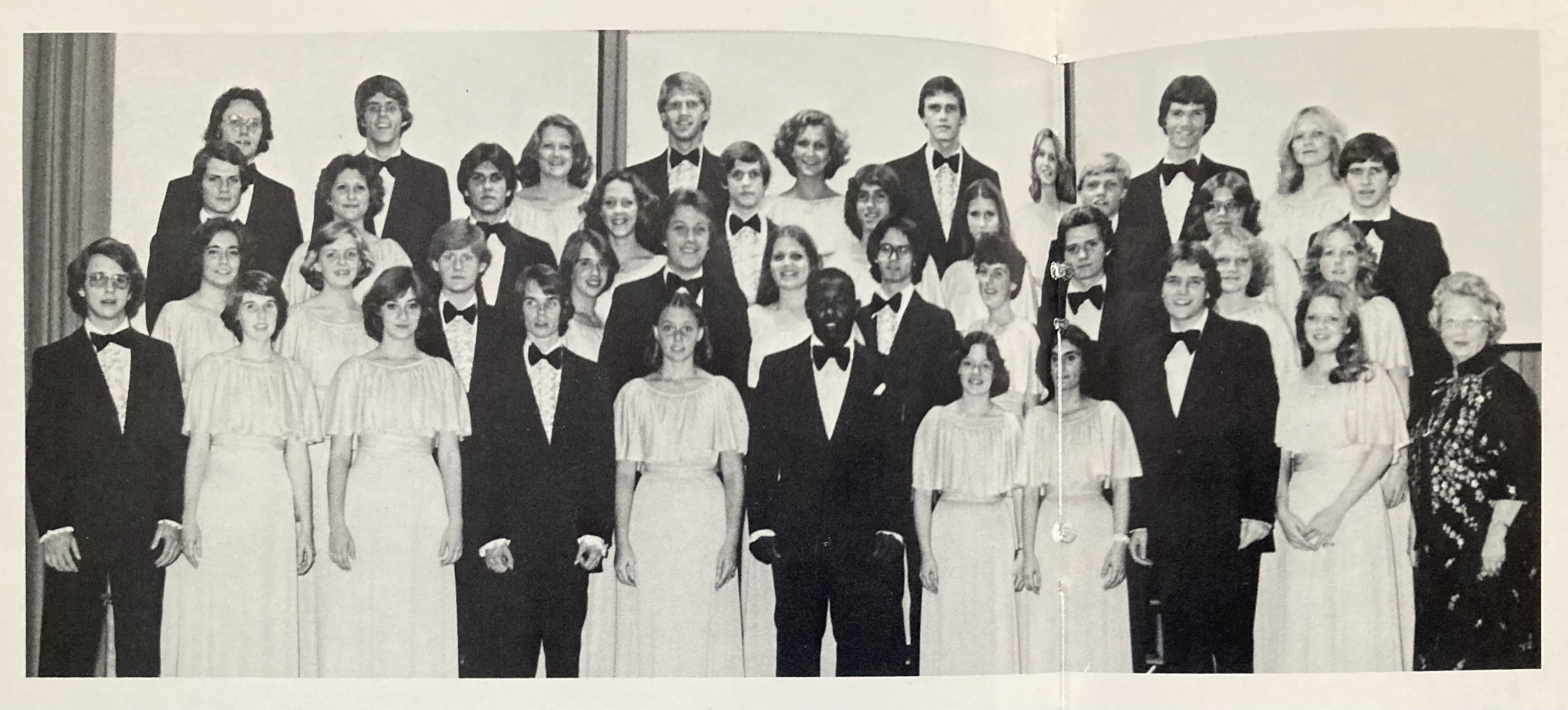
The year in Chorus was a nightmare, but I survived. When I think back on it now, I don’t think, how brave I was, how determined! I only remember desperation. How could I be with my friends as much as possible? The incredible thing is how accommodating they all were, how accepting of my lack of talent, how glad, always, to have me along, or at least so it seemed.
In my final year at Broughton, I became a little cog in the school’s music and theater world. It started at the end of junior year with Guys and Dolls. I was part of the chorus – I even dated one of the dancers. But it was senior year that I think of as “the year of three musicals.”
First came Damn Yankees. I played Vern.
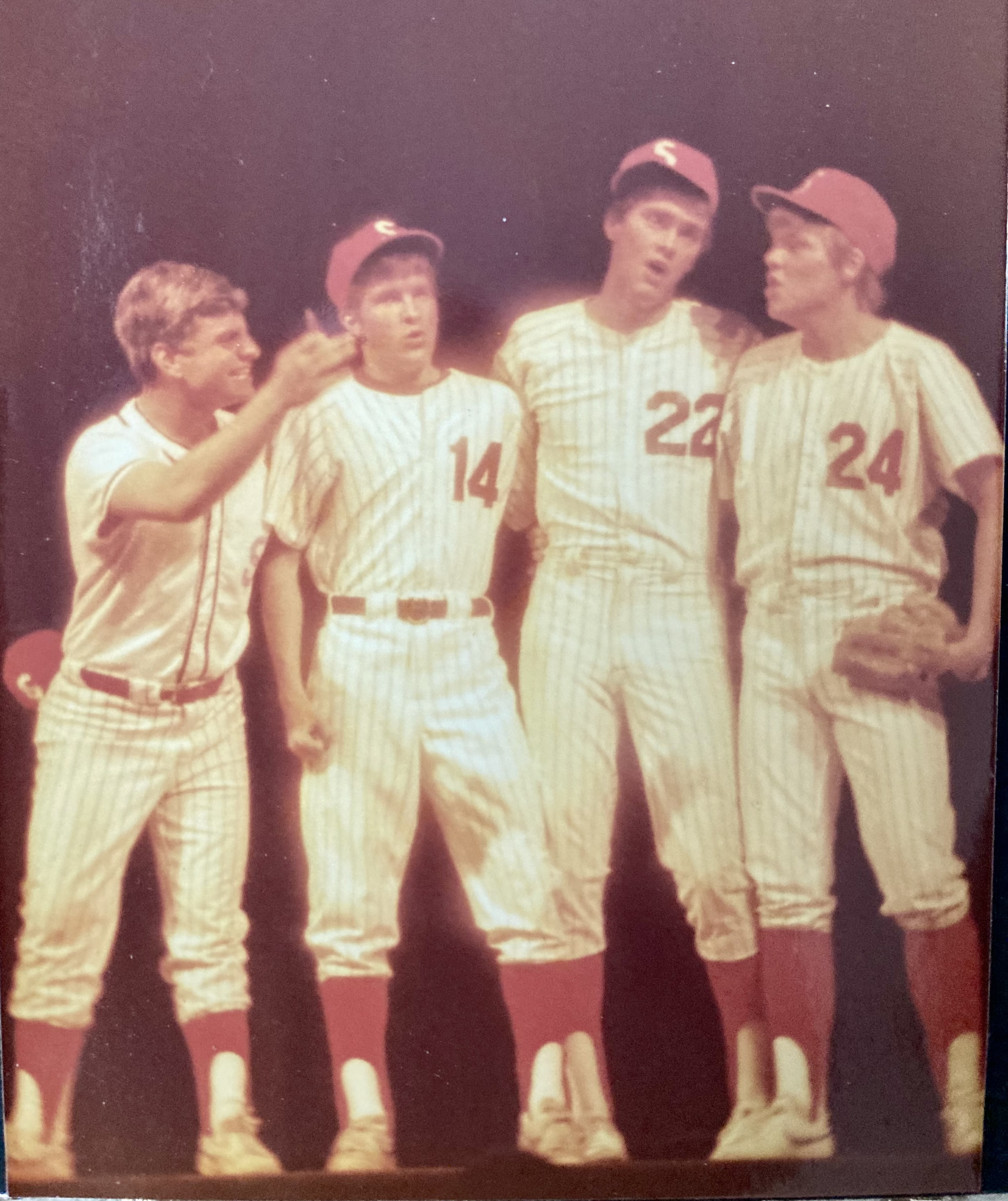
You’ve gotta have heart!
All you really need is heart –
When the odds are sayin’ you’ll never win,
That’s when the grin should start!
Next was Burger Baby, an original musical about a boy and girl who fall in love at a fast food restaurant. It was written – words, music, and book – by Brent. Still today I find this hard to believe; even at the time, we were all stunned – not just that he had written an entire musical, but how good it was. It wasn’t Sweeney Todd, but it was catchy, joyful, full of energy and life. In fact, Brent, at 18, had been writing and directing musicals for years. This was just his latest.
I played the captain of the French Fry army. I have a vivid memory of marching onto the stage with my crew behind me. There was one song that I had a small solo part in. But I also remember being part of the finale, singing the title song while we did a can-can line.
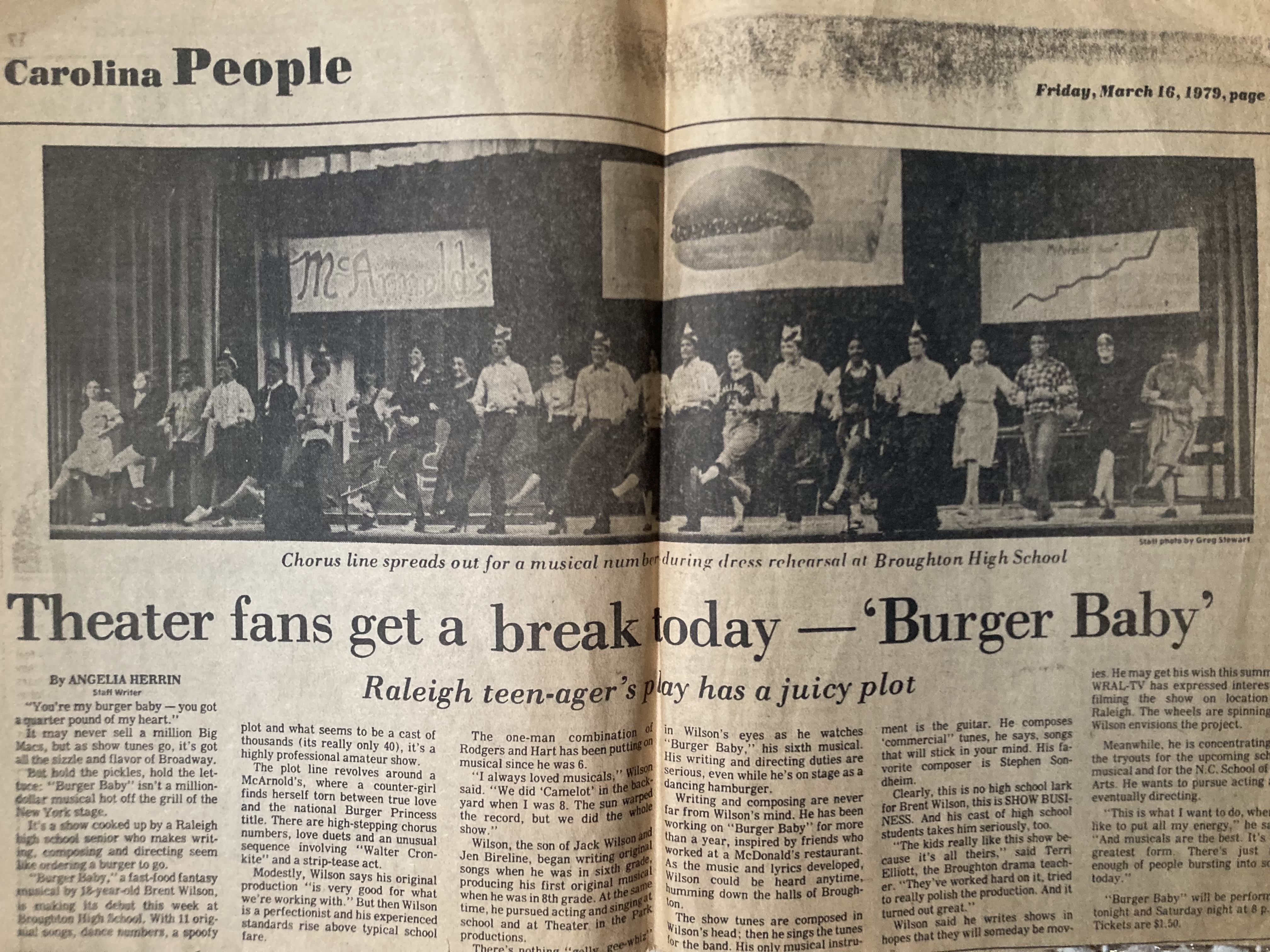
All my friends were involved in one way or another; and, if I did no great credit to the show, the collected talent was, by any estimation, remarkable. There was a small orchestra, made up of our friends and directed by Jim; they accompanied us every night. There was a tech crew that handled lighting and sound, scenery designers and costumers – all friends. Wendy was the director. Neal and Sharon played the leads. We did it all ourselves, everything – I don’t remember a single adult helping us in any way.
Brent, who created the whole thing, could have been controlling and impatient. But I only remember his great joy and love for what we were doing together. What confounds me now is how he could have entrusted a part to me. Yet I don’t remember him ever complaining or being disappointed.
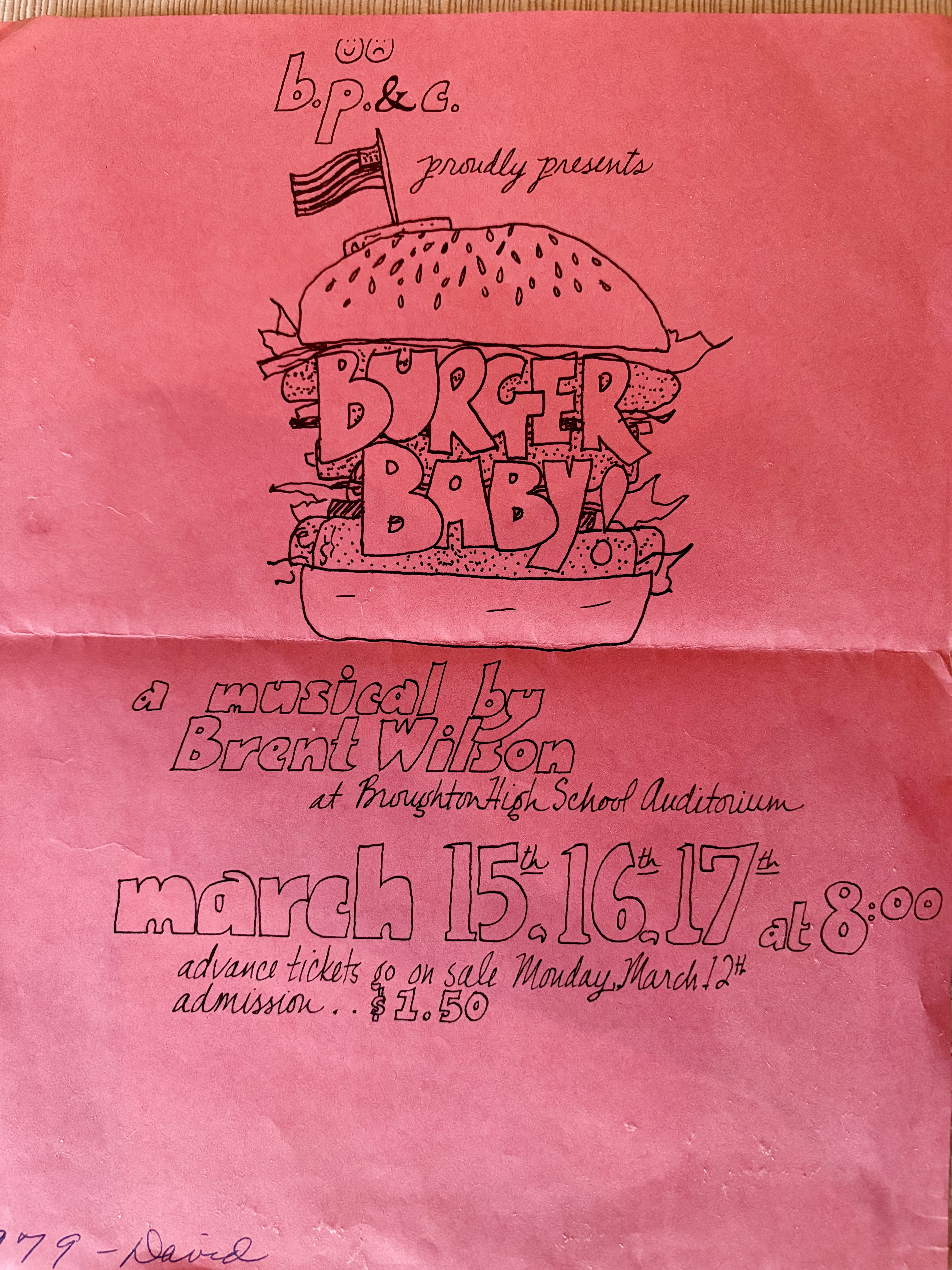
Burger Baby was a hit. It ran only one weekend – maybe that’s all the use of the auditorium that the school allowed us. But it was a thrilling experience.
That summer, we reprised the show for the local TV station, WRAL. Astoundingly, I don’t recall ever watching it, and I’ve never seen it since or heard the soundtrack. What’s worse, the only photograph I have of any of it is from the local newspaper, above. It didn’t occur to us to make a record of the experience. And when it was all over, we moved on: it was senior year – we all had lives ahead of us!
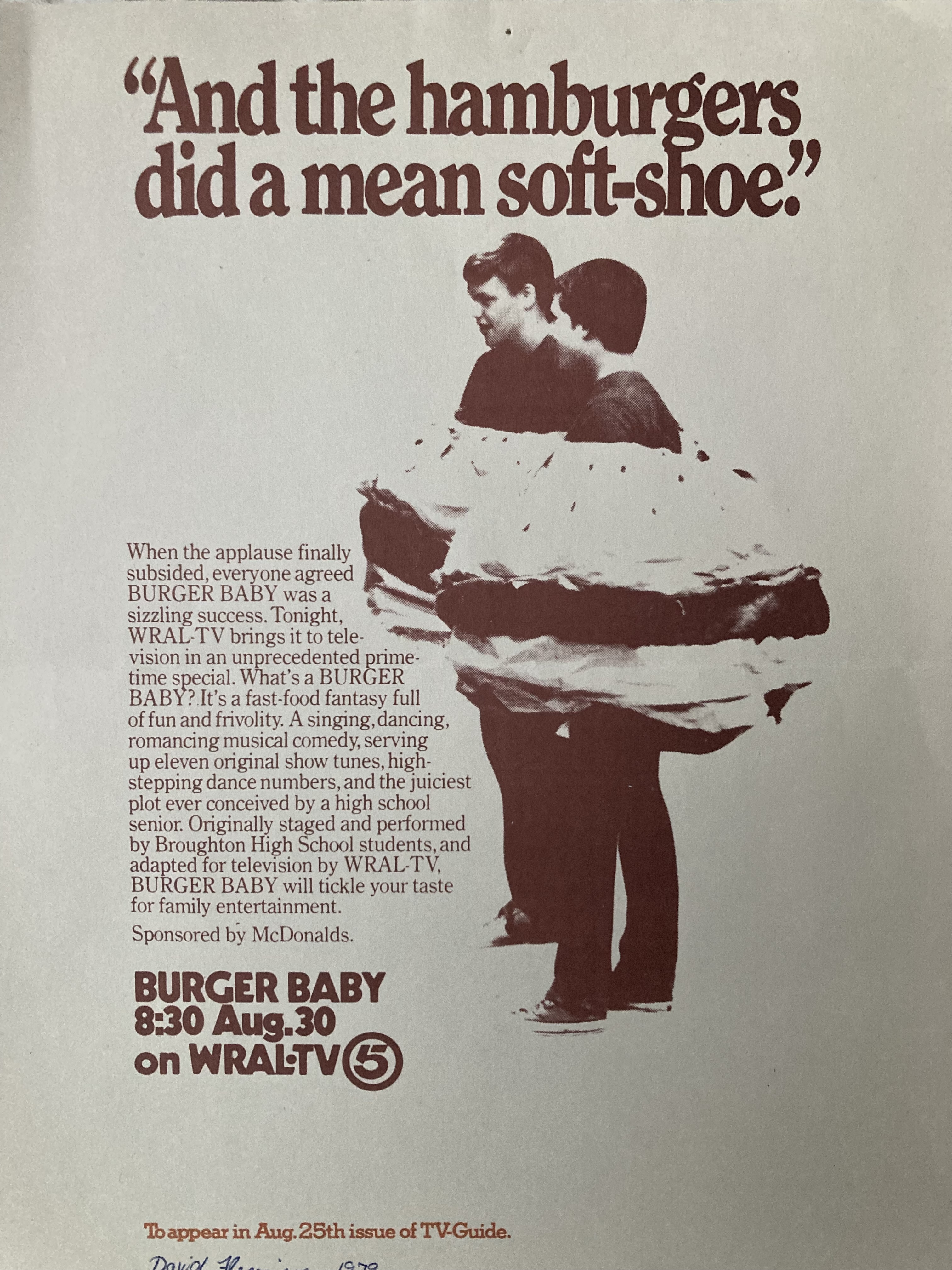
Years later, in my mid-twenties, when I was living in Washington, DC, I worked for a time with a young man my age who also happened to be from North Carolina, though from a different town. When he found out I had gone to Broughton, he looked at me, suddenly very serious, and asked, “Were you in Burger Baby?” He had seen it on TV and never forgot it.
After we graduated, in the summer of 1979, there was one more show to do. Brent asked me to play Hucklebee in The Fantasticks, which we put on that summer at Meredith College. Brent did it all – acquired the rights, rented the auditorium, and charged enough in tickets to make most of his money back. He was like Mickey Rooney in Babes in Arms: he just liked putting on shows with his friends.
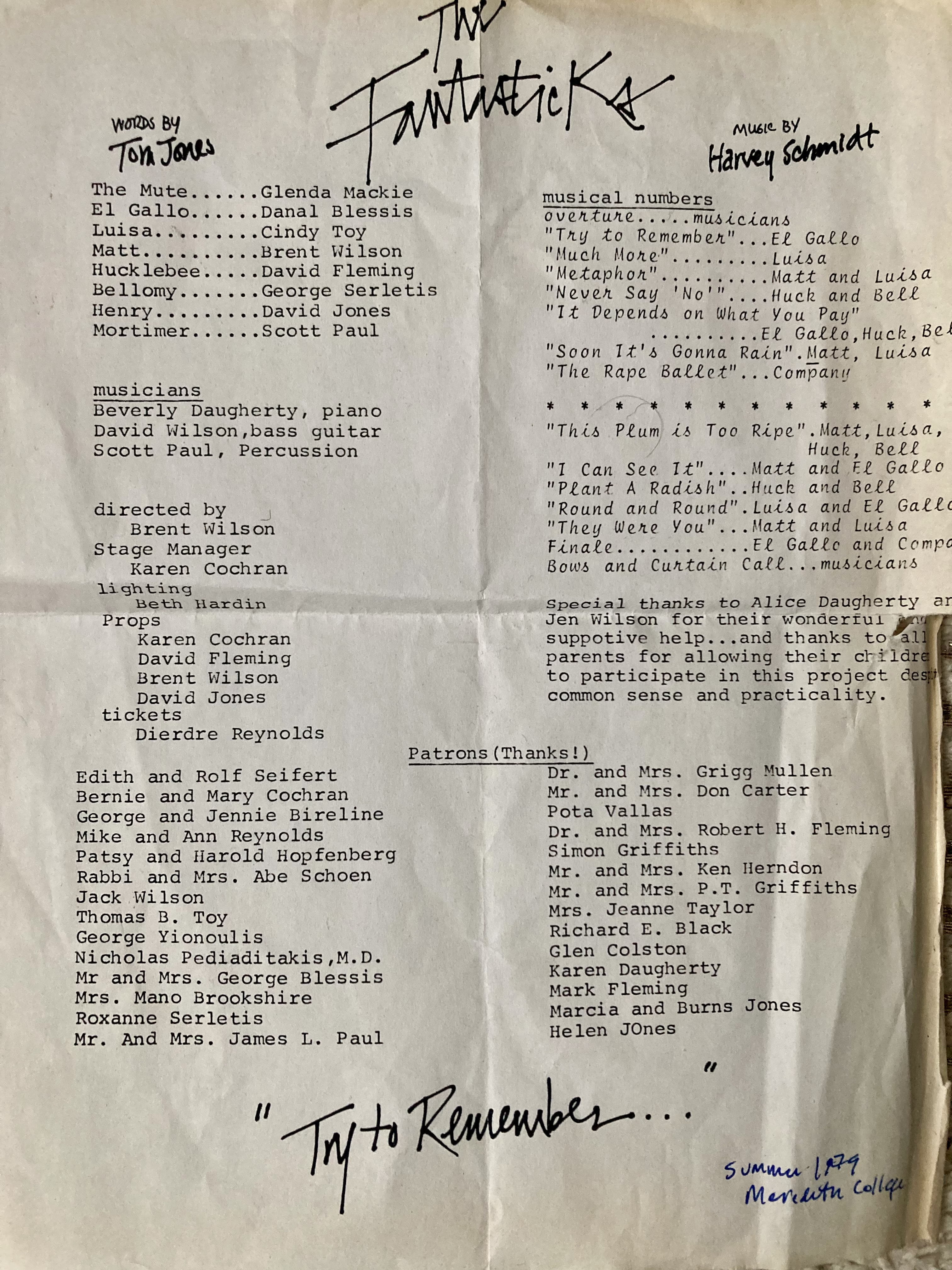
I can see on the flyer that my parents and brother Mark made donations, and I remember my sister Susie and her friends coming to the dress rehearsal.
On the last night of the show, I stood in the wings as one of the actors sang:
Try to remember the kind of September
When no one wept except the willow
Try to remember the kind of September
When dreams were kept beside your pillow
When I went to college that fall, I simply sloughed off all the parts of myself tied to theater and music and started fresh. I joined a fraternity, studied history, thought for a time about becoming pre-law. But I finished as an English major with enough coursework in art history to count as a minor. I had caught the traveling bug. I thought I might teach or write. I never again acted on the stage or sang in public.
But my high school years had their long-term effect. For one thing, they saved Raleigh for me. Except for a summer here and there, I never again lived in that city. But I look back with fondness at those years.
Broughton in particular gave me three things. First, it helped me see a bigger world in my hometown than I ever knew was there – it was a lesson I never forgot. Thoreau once said of Concord that it would take a lifetime to fully explore it. I felt that as a teenager in Raleigh: that the town I had grown up in, I didn’t actually know that well.
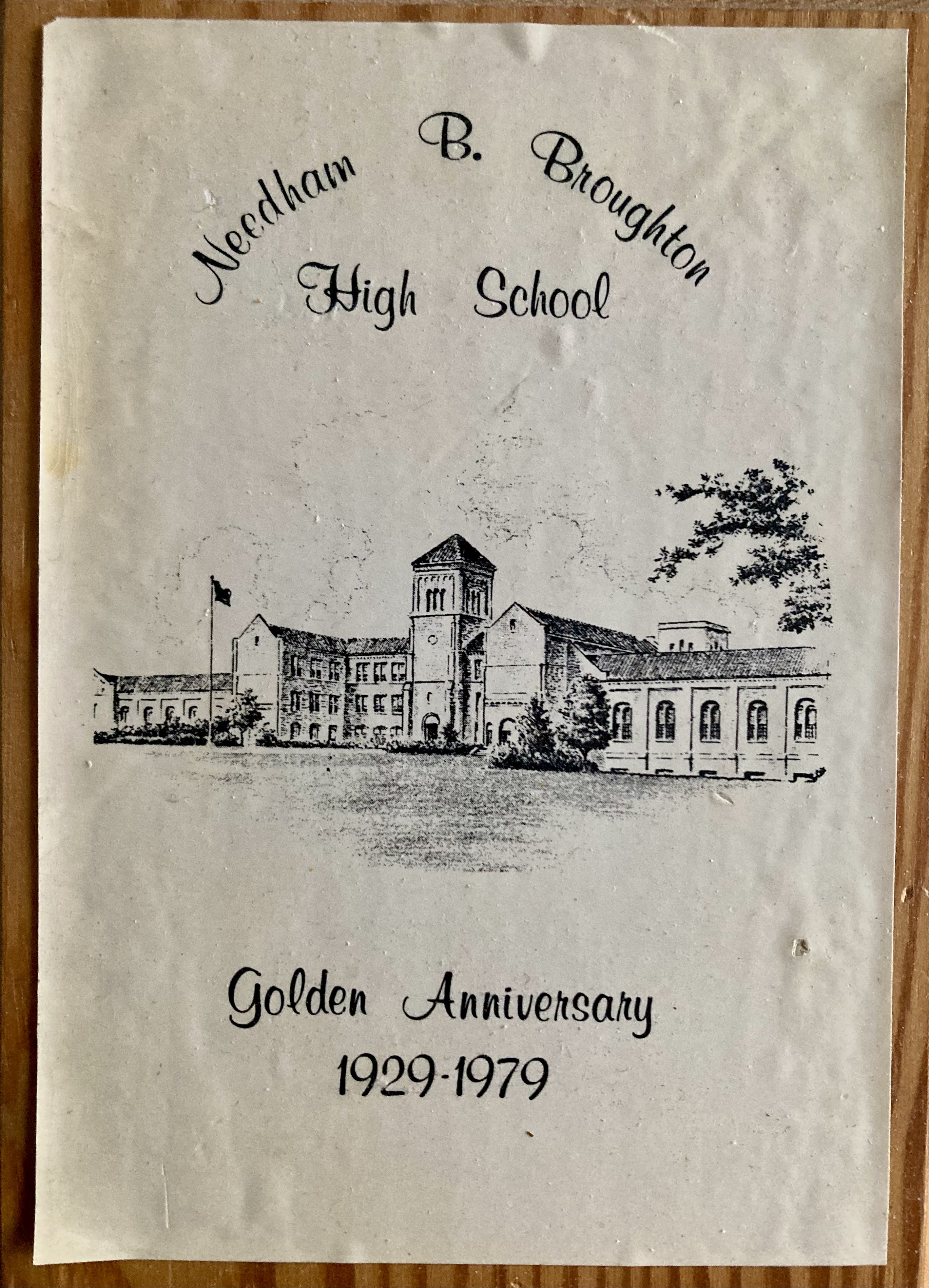
Second, Broughton left an abiding image for me of the large American public high school, so vibrant, so diverse, with so many sub-communities, so many opportunities for involvement and growth. Compared to secondary education in other countries, our high schools can look unserious. All those marching bands, homecoming parades, and spring musicals. But a place like Broughton offers something for everyone, some club, team, subject, activity. Today, with charter schools, magnet schools, STEM schools, performing arts schools, it’s useful to recall the old comprehensive high school that tried, crazily, to be all things to all people – and very nearly succeeded.
The third thing I got from Broughton was a lifelong love of the arts. Music, poetry, fiction, drama, painting, photography, dance. Broughton opened doors to them all. But more, it introduced me to the kind of people who took advantage of those opportunities and charted their lives on that basis. It’s easy to ridicule high school musicals, community theater, and the people who take to such things. But if you’ve ever been involved in that world, even for a season, you realize that what drives the people in it is the joy of being with one another. What I remember most about Burger Baby was not the performances, as exhilarating as they were, but the long afternoons together, in rehearsal, working out a scene or practicing a song. It was creating something, together, that was so much fun.
At some point during my senior year at Broughton – it must have been early 1979, in the winter – Raleigh had a rare snowstorm. It was clear that there would be no school the next day. Several of us met up in Cameron Park for a huge sleepover – perhaps at Brent and David’s? That night, we all went out in the snow and made our way to . . . Broughton! It was just a few blocks away. We snuck into the gym through a side door and played basketball in the dark in our socks.
How much we must have loved that school to break into it on a snow day!
I gradually lost touch with Neal. But I have remained close to Wendy: there has never been a time in the last 50 years when we were not in touch in some way, even living on different coasts. I’ve seen her only a handful of times, yet she remains one of the most important people in my life.
As for Scott, he went on to get a PhD and become a wildlife biologist, writing textbooks, leading important research projects, known around the world. In 2018, Scott’s team published groundbreaking research in the journal Science about animals that undergo seasonal color change in environments with decreasing snow duration. What happens to a brown hare, for example, when his winter white coat has no snow to blend in with? when environmental adaptation is hurting, not helping?
Around the time that paper was published, Scott came to UMass Amherst to give a talk, and I went to hear him. There were probably a hundred people in the room, most I didn’t know. In his opening remarks, he said there was someone he wanted to recognize. He mentioned my name and gestured to me, sitting in a row in front of him. “One of the Fern Hill Boys,” he said, without explanation. I could not have been more proud.
In the sun that is young once only,
Time let me play and be
Golden in the mercy of his means.
For those of you who stuck with me this far, here’s a treat from 1976:
For more about the “tall ships” that gathered in New York harbor on July 4, 1976, go to The Gotham Center for New York City History.
Read “Fern Hill” by Dylan Thomas here.
Photographs of Raleigh from the 1970s come from NC State University.
Photographs from old Latipacs are courtesy of DigitalNC.
Read the first installment of Armistead Maupin’s “Tales of the City,” May 24, 1976.
Armistead Maupin writes about Mrs. Peacock in a recent Substack essay.
The chapter from Reynolds Price’s memoir Ardent Spirits, in which he writes about Mrs. Peacock and Anne Tyler, is available here.
Ricki Morell’s article “Orchids for Mrs. Peacock” was published by the Charlotte Observer, December 6, 1992: 1A.
A collection of obituary notices for Mrs. Peacock can be found here.
The obituary for Mrs. Wooten can be found here.
Click here to learn about the Philip Watts Foundation.
Mrs. Freeman’s obituary can be found here.
I wrote an earlier post about Raleigh’s first streetcar lines, and the suburbs they helped create, including Cameron Park. For more on Cameron Park, click here and here.
I wrote about my parents and Raleigh here.
Click here and here for more information about Needham Broughton High School from the Raleigh Historic Development Commission.
Scott’s 2018 paper in Science can be found here.


This post touched me deeply. How rare and special to read about so many people, places, and events I remember well. I have such fond memories of my teenage years in Cameron Park among the many creative, smart, and interesting folks you mention; and attending Broughton, where my personal favorite teacher was Sally Smisson, whose “five a day” vocabulary words never failed me over the years. At least a few of these fond memories included you, though I didn’t know a lot of what you were involved with in junior and senior years. We moved in different circles much of the time — I remember your being in French club but had lost the fact that you also studied German, along with several of my friends — but you were always there, always a positive presence. Thank you for sharing all this; I learned quite a few new things, as I smiled and nodded along.
Just couldn’t love this more…i hope wendy and brent and all have read this? ________________________________
I don’t think I ever knew you had a theater past! What interesting characters to read about. I have always thought Broughton looked like such an interesting place from the outside and now I know the same is true for the inside.